- What Are Artificial Flower Trees?
- Why Source Flower Trees from China?
- 5 Quality Factors to Check Before You Buy
- Price Tiers: What to Expect at Each Budget Level
- How to Choose the Right Supplier
- Customization & MOQ
- Shipping, Lead Times & Logistics
- 5 Common Mistakes to Avoid
- Recommended Starter Inventory
- FAQ
Artificial flower trees are one of the fastest-growing categories in event rentals. They create instant drama, transform empty corners into focal points, and clients are willing to pay premium prices for that lush, garden-inspired look — without the hassle of real trees.
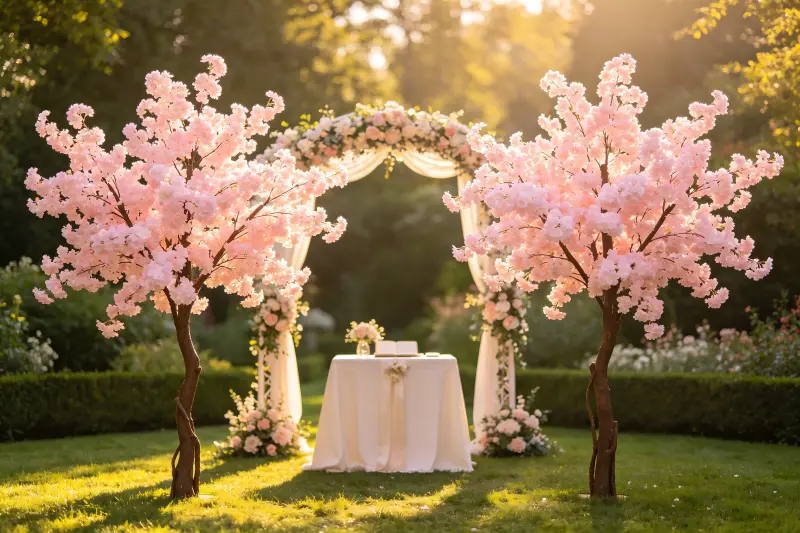
Think about it: a 7ft cherry blossom tree flanking a ceremony altar, mini flower trees as table centerpieces, a pair of gradient pink trees framing an entrance — these are statement pieces that photograph beautifully and elevate any event.
But here's the challenge: finding quality flower trees at wholesale prices that hold up to repeated use, transport well, and look realistic enough for high-end events.
Source the wrong products, and you'll deal with shedding flowers, wobbly trunks, and faded colors after just a few uses. Source the right ones, and you'll have inventory that pays for itself in 1-2 events and keeps generating revenue for years.
In this complete guide, we're covering everything you need to know about sourcing artificial flower trees wholesale — from quality checks and price tiers to supplier selection, customization, shipping, and the most common mistakes to avoid.
What Are Artificial Flower Trees?
Before we dive into sourcing, let's clarify what we're talking about. Artificial flower trees are freestanding decorative trees with synthetic trunks and branches, covered in artificial flowers or foliage. They're designed to look like real flowering trees but require zero maintenance.
Here are the main product types:
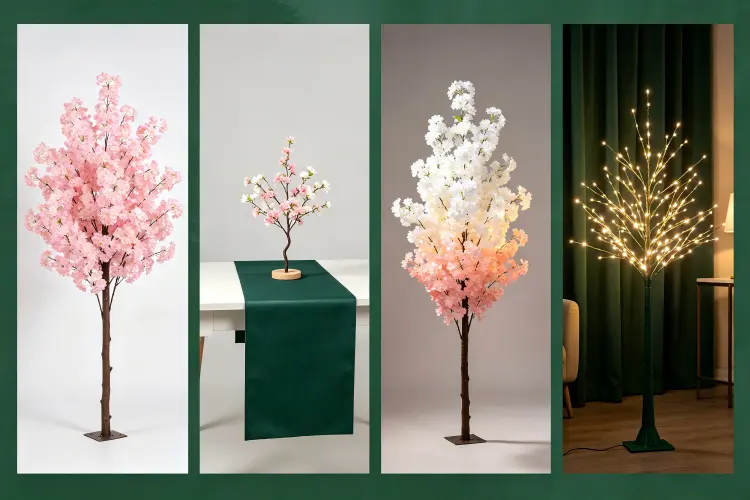
Cherry Blossom Trees — The #1 most popular flower tree. Lush pink or white blossoms on spreading branches. Available in 4ft, 5ft, 6ft, 7ft, and 8ft+ sizes. 6-7ft is the bestseller for rentals.
Mini Tabletop Flower Trees — Small 2-3ft trees designed as table centerpieces. Fastest-growing category. Perfect for weddings, corporate events, and restaurants.
Gradient Color Trees — Trees with flowers that transition from one color to another (e.g., white to blush, pink to purple). Very trendy and Instagram-worthy. Higher rental value.
Greenery & Foliage Trees — Trees with just leaves and greenery, no flowers. Great for minimalist and boho events. Often used as backdrop greenery or entrance pieces.
LED Light-Up Trees — Flower trees with built-in LED lights in the branches or trunk. Perfect for evening events and create a magical ambiance. Premium rental value.
Custom / Branded Trees — Fully custom colors, flower types, or shapes for corporate events, retail displays, or brand activations. Highest price point and profit margin.
For most rental businesses just starting out, a 6-7ft cherry blossom tree plus a few mini tabletop trees are the best investment. They're versatile, always in demand, and photograph beautifully.
Why Source Flower Trees from China?
If you're currently buying flower trees from local home decor stores or online retailers, you're probably paying 2-3x more than you need to. Sourcing directly from China manufacturers can save you 40-60% — and the quality is often better.
Here's why China is the best source for artificial flower trees:
Lower Manufacturing Costs — Labor and materials cost significantly less in China. Even with shipping included, you'll pay far less than local retail or wholesale.
Wide Customization Capabilities — Chinese factories can make any size, color, or flower type you want. Want a 7ft gradient blush-to-white cherry blossom tree? No problem. Need a custom corporate color? They can do it.
Better Quality Materials — The top factories use commercial-grade flowers and sturdy trunks that last 3-5 years. Better than many "premium" local options that use cheap materials.
Bulk Pricing Discounts — The more you order, the lower the per-unit cost. For rental businesses building inventory (5-20 trees), the savings are substantial.
Faster Production — Most standard designs ship in 7-15 days. Custom designs take 15-25 days. Faster than many local custom makers who can take 4-6 weeks.
The key is choosing the right supplier. Quality varies wildly — which is why the rest of this guide is so important.
5 Quality Factors to Check Before You Buy
Not all flower trees are created equal. Here are the 5 quality factors you must check before placing a wholesale order:
Factor 1: Trunk & Branch Structure
This is the foundation. A flimsy trunk means your tree will wobble, tip over, or break during transport.
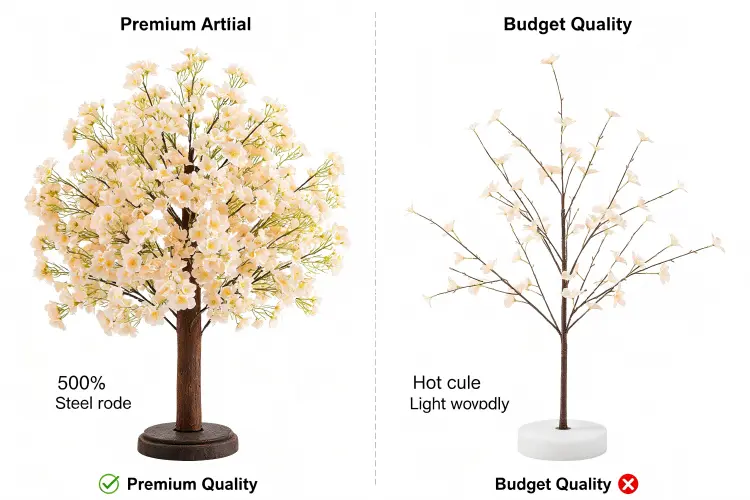
- Good: Solid wood or thick metal trunk with internal steel rod. Branches are wired and hold their shape. Stable base that doesn't wobble.
- Bad: Thin plastic trunk with no internal support. Branches droop or snap off. Wobbly base.
- How to check: Ask about trunk material and internal structure. Request photos of the base and branch connections.
Factor 2: Flower Density & Coverage
Can you see bare branches through the flowers? If yes, it's low quality.
- Good: Dense flower coverage with no visible bare branches. Looks full and lush from every angle. 300-500+ flower heads on a 6-7ft tree.
- Bad: Sparse flowers with lots of visible branches. Looks cheap and unfinished.
- How to check: Ask for flower count per tree. Request photos from multiple angles (front, side, back).
Factor 3: Flower Attachment Method
How are the flowers attached to the branches?
- Good: Each flower is individually glued AND wired to the branch. Won't shed during transport or setup.
- Bad: Flowers are just pushed onto plastic stems or hot-glued. Shed easily, especially during shipping.
- How to check: Ask about attachment method. Order a sample and give it a good shake.
Factor 4: Flower Quality & Realism
Do the flowers look real or obviously fake?
- Good: High-quality silk/PE flowers with realistic colors and textures. Multiple flower sizes and shades for natural depth.
- Bad: Cheap plastic flowers that look obviously artificial. Single shade, flat appearance.
- How to check: Ask for close-up photos. Order samples to see and feel in person.
Factor 5: Base Design & Stability
How does the tree stand up? Is the base stable and well-made?
- Good: Heavy, wide base (metal or weighted plastic) that prevents tipping. Removable base for transport. Non-slip bottom.
- Bad: Light, narrow base that tips over easily. No way to secure the tree.
- How to check: Ask about base weight and dimensions. Request photos of the base.
Price Tiers: What to Expect at Each Budget Level
Flower tree prices vary a lot based on size, quality, and type. Here's what you can expect at each price tier (for a standard 6-7ft tree):
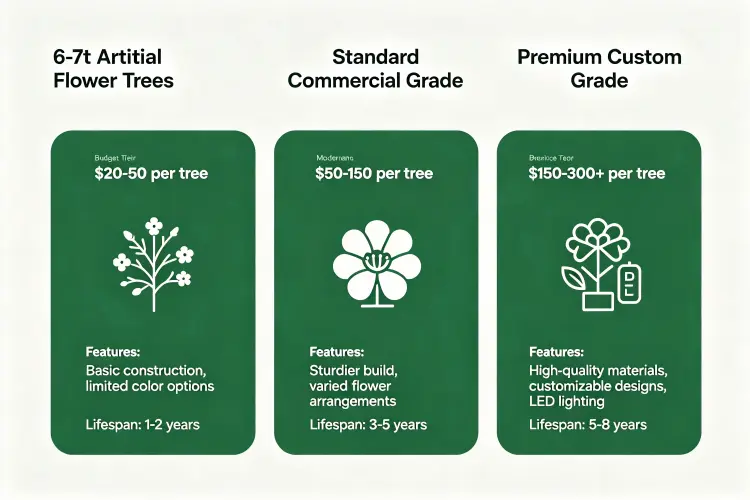
Budget Tier: $20 – $50 per tree
- What you get: Thin plastic trunk, sparse cheap plastic flowers, light base. Usually 4-5ft max.
- Best for: One-time events, DIY buyers, very budget-conscious clients.
- Lifespan: 10-20 uses before they start falling apart.
- Rental value: Low. Clients can tell they're cheap.
- NOT recommended for rental businesses.
Standard Commercial Grade: $50 – $150 per tree
- What you get: Wood/metal trunk, good quality silk/PE flowers, dense coverage, stable base. 6-7ft height.
- Best for: Most rental businesses, standard weddings and events.
- Lifespan: 30-50+ uses with proper care.
- Rental value: Good. Clients love the look, and they hold up well.
- RECOMMENDED starting point for new rental businesses.
Premium Custom Grade: $150 – $300+ per tree
- What you get: Premium trunk, ultra-realistic flowers, very dense coverage, mixed flower types, custom colors, LED options, heavy base.
- Best for: High-end weddings, luxury events, corporate brand activations.
- Lifespan: 50-80+ uses.
- Rental value: Excellent. You can charge premium rental rates.
- Great for upselling. Offer standard and premium tiers to maximize revenue.
Note: Mini tabletop trees (2-3ft) cost $20-50 each (standard grade) and rent for $25-60 per event. LED light-up trees cost 30-50% more than standard trees but rent for 50-100% more.
How to Choose the Right Supplier
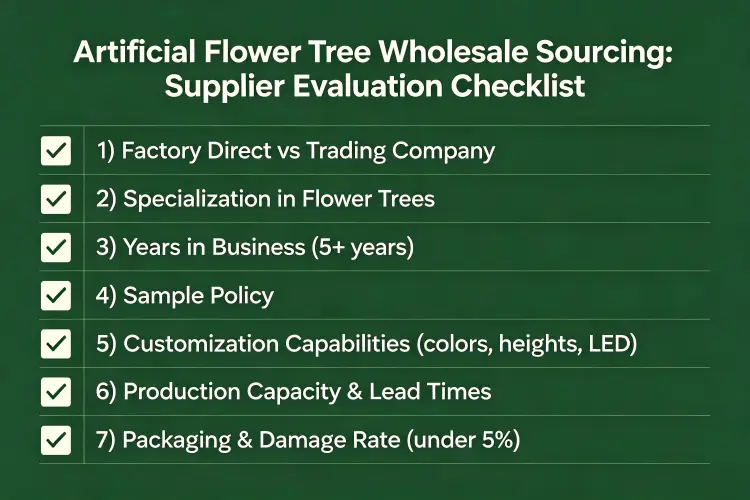
The supplier you choose makes all the difference. Here are 7 criteria for evaluating flower tree suppliers:
1. Factory Direct vs Trading Company
Always go factory direct when possible. Trading companies add 20-50% markup and often can't answer technical questions. Look for suppliers that show factory photos, production lines, and have verifiable manufacturing addresses.
2. Specialization in Flower Trees
Avoid general "artificial flower" factories that make everything from bouquets to Christmas trees. Look for suppliers that specialize in trees and large plants — they'll have better quality, more options, and deeper expertise in trunk construction and stability.
3. Years in Business
5+ years is a good benchmark. New factories pop up every year, and many disappear just as fast. Established suppliers have refined their processes and are more likely to still be around when you need reorders.
4. Sample Policy
Any reputable supplier will happily send you samples (you usually pay for samples + shipping). If a supplier refuses to send samples or wants you to place a bulk order sight unseen, run. Samples cost $30-100 each — cheap insurance against a bad bulk order.
5. Customization Capabilities
Can they do custom heights? Custom colors? Custom flower types? LED integration? For a rental business, customization is valuable — you can offer exclusive designs that competitors don't have. Ask about their custom process and minimums.
6. Production Capacity & Lead Times
How fast can they produce your order? For standard designs, 7-15 days is normal. For custom orders, 15-25 days. If a supplier says "2 months" for a standard order, they're probably too small or too busy to be reliable.
7. Packaging & Damage Rate
How do they package the trees for shipping? Flower trees can get crushed or have branches broken if not packaged properly. Ask about packaging methods (do they disassemble branches? use protective tubes?) and what their damage rate is. Under 5% is good.
Customization & MOQ
One of the biggest advantages of sourcing from China is customization. Let's walk through how it works:
The Customization Process
- Send your design — Share your idea, reference photo, or color palette. Be specific about height, flower types, and any special features (LED, gradient).
- Get a quote — The supplier will quote you a price based on size, complexity, and quantity.
- Approve the sample — They'll make a physical sample and send you photos (or ship it to you).
- Production — Once approved, they start production. Standard custom: 15-20 days. Complex custom (LED, gradient): 20-25 days.
- Quality check — They should send you photos of the finished trees before shipping.
- Shipping — Packed and shipped to your door.
Minimum Order Quantity (MOQ)
- Standard designs (pre-made colors/sizes): 1-2 pieces MOQ
- Custom colors: 5-10 trees per color
- Custom flower types: 5-10 trees
- LED integration: 3-5 trees
- Custom heights: Usually no extra MOQ, just higher per-unit price
Sample Orders — The Smart Way to Test
Always order samples before placing a bulk order. Here's how:
- Order from 2-3 suppliers at once. Compare quality side by side.
- Test everything: shake it, check flower attachment, inspect the trunk and base.
- Evaluate communication: How fast do they respond? Do they answer questions thoroughly?
- Time the delivery: How long does shipping take? Is the packaging good?
Sample orders cost $50-200 total — worth every penny to avoid a $1,000 mistake.
Shipping, Lead Times & Logistics
Shipping flower trees requires more care than shipping flat items like flower wall panels. Here's what you need to know:
Production Lead Times
- Sample orders: 3-7 days
- Standard bulk orders (pre-made designs): 7-15 days
- Custom orders: 15-25 days
- Peak season (March-June): Add 5-10 days
Shipping Options
- Express (DHL/FedEx/UPS): 3-7 days. Best for samples and small orders (1-3 trees). Cost: $40-100 per tree.
- Air freight: 7-15 days. Good for medium orders (3-10 trees). Cost: $25-60 per tree.
- Sea freight: 25-45 days. Best for large orders (10+ trees). Cost: $10-30 per tree. Much cheaper, but slower.
Packaging is Critical
Flower trees are bulky and can have branches broken during shipping. Make sure your supplier:
- Disassembles or folds branches for shipping (if possible)
- Uses protective foam or bubble wrap on the trunk and branches
- Uses thick, sturdy cardboard tubes or boxes
- Separates the base from the tree for safer shipping
- Includes assembly instructions
For most rental businesses placing their first order:
- Start with express or air freight for your initial order. Faster, and you can start renting sooner.
- Switch to sea freight for reorders once you know what sells. The savings are significant.
Customs & Duties
- You'll likely need to pay import duties when the trees arrive in your country.
- Rates vary by country and product type. Artificial plants/trees are usually 5-15% duty.
- Ask your supplier for help with customs documentation. Good suppliers will provide all the paperwork you need.
5 Common Mistakes to Avoid
Learn from others' mistakes. Here are the 5 most common mistakes new buyers make when sourcing flower trees wholesale:
Mistake 1: Buying Based Only on Price
The cheapest option is almost never the best value. Those $30 flower trees might seem like a steal, but if they shed everywhere, wobble, and look cheap, you've wasted your money. Always prioritize quality over lowest price, especially for rental inventory that needs to last.
Mistake 2: Not Ordering Samples First
This is the #1 mistake. Placing a $1,000 bulk order without seeing or touching the product first is gambling. Samples cost $50-100 — that's cheap insurance. Always test before you invest.
Mistake 3: Ignoring Trunk & Base Quality
Many buyers only look at the flowers and forget about the trunk and base. But the trunk is what holds everything together, and the base is what keeps it from tipping over. A wobbly tree is a liability at events. Always ask about trunk material and base weight.
Mistake 4: Underestimating Size Needs
A common mistake: ordering a 4ft tree and realizing it's too short for most ceremony backdrops. For reference: 6-7ft trees are the most popular for ceremony and entrance decor. 2-3ft mini trees are for tables. Always measure your typical venue before ordering.
Mistake 5: Not Considering Transport & Storage
Flower trees are bulky. Before you order 10 of them, make sure you have a way to transport them (do they fit in your van?) and store them (do you have space?). Some trees disassemble for easier transport — ask about this before ordering.
Recommended Starter Inventory
If you're just starting with flower trees, here's our recommended starter inventory:
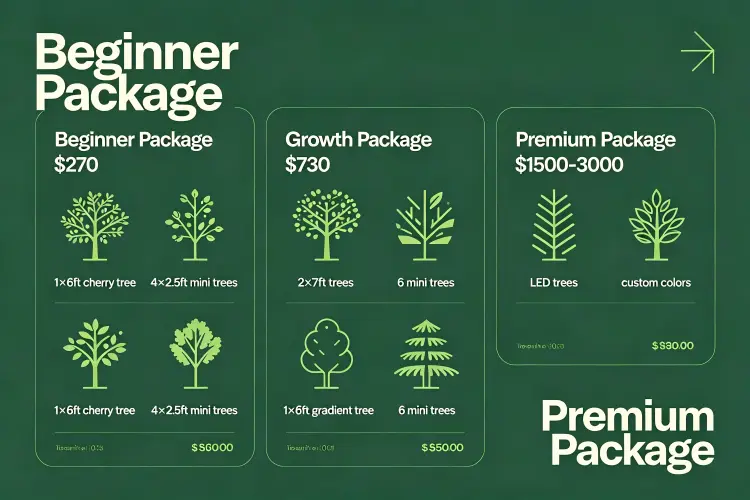
Beginner Package (Under $500)
- 1 × 6ft cherry blossom tree (standard commercial grade, pink) — ~$100
- 4 × 2.5ft mini tabletop trees (standard grade, white/pink) — ~$120
- Transport/storage bags — ~$30
- Touch-up repair kit (extra flowers, glue) — ~$20
- Total: ~$270
- What you can do: Ceremony accent, entrance decor, table centerpieces
- Expected ROI: 1-2 events to pay back (at $100-200 per tree rental + $25-60 per mini)
Growth Package ($500 – $1,500)
- 2 × 7ft cherry blossom trees (standard commercial grade, pink/white) — ~$240
- 1 × 6ft gradient color tree (premium grade) — ~$180
- 6 × 2.5ft mini tabletop trees (standard grade, mixed colors) — ~$180
- Transport cases — ~$80
- Repair kit + extra flowers — ~$50
- Total: ~$730
- What you can do: Matching ceremony pairs, entrance framing, multiple tables, corporate events
- Expected ROI: 2-3 events to pay back
Premium Package ($1,500+)
- Everything in the Growth package, plus:
- Upgrade to premium grade flowers
- Add 2 × LED light-up cherry blossom trees (7ft) — ~$500
- Add custom color trees (blush, burgundy, white) — ~$400
- Add 8ft giant statement tree — ~$250
- Add more mini trees for full table coverage — ~$200
- Total: $1,500 – $3,000
- What you can do: Luxury weddings, high-end corporate events, premium pricing tier, full venue transformation
- Expected ROI: 3-5 events to pay back, but higher per-event revenue
FAQ
6-7ft trees are the most popular for ceremony backdrops, entrance ways, and large event spaces. They're tall enough to make a statement but not so tall that they're hard to transport. 2-3ft mini tabletop trees are the fastest-growing category — perfect for table centerpieces and smaller spaces.
Rental prices vary by location and tree size/type. A standard 6-7ft tree rents for $75-200 per event in most markets, $150-350 in larger cities, and $250-500+ in luxury markets. LED or gradient premium trees rent for 50-100% more. Mini tabletop trees rent for $25-60 each. A pair of matching 7ft trees for a ceremony typically rents for $200-500.
With proper care, standard commercial grade flower trees last 30-50+ uses. Premium grade lasts 50-80+ uses. The main things that wear them out are rough handling (broken branches, crushed flowers), sun exposure (fading), and poor storage. They're relatively low-maintenance compared to other rental products.
Yes, but with caution. Make sure the flowers are UV-resistant if they'll be in direct sun. Wind is the main concern — tall trees can tip over. Always use a heavy base or sandbags for outdoor use. Never leave them outside overnight, and bring them inside if it rains heavily. Some trees are specifically designed for outdoor use with weather-resistant materials.
Transport them upright or carefully laid flat in protective covers. Don't stack heavy items on top. For trees with detachable branches, remove branches and store separately. Store them in a cool, dry place away from direct sunlight. For large inventories, consider building custom storage racks where trees can stand upright. Always inspect and repair after each rental.
That depends entirely on quality. Good quality trees have securely glued and wired flowers that won't shed during normal use. Cheap trees have flowers that are just pushed onto stems and shed easily. Always order a sample and give it a good shake to test. If you're losing more than a few flowers per event, the quality is too low for rental use.
Absolutely. Most suppliers offer extensive customization including custom color matching, gradient/ombre schemes, mixed flower types (cherry blossom, rose, hydrangea), greenery additions, and custom height. Custom trees usually have higher MOQ (5-10 trees per color) and longer lead times (15-25 days). For rental businesses, having 2-3 color options covers most wedding themes.
Flower trees have one of the best ROIs in event rentals because they're statement pieces that command high rental prices. A $100 standard 6ft tree rented 20 times a year at $100 generates $2,000 annually — that's 1,900% ROI in the first year. Even at 10 rentals per year, ROI is 900%. A quality flower tree lasts 3-5 years, so total ROI is even higher. Mini tabletop trees have similarly excellent ROI.
Ready to Add Flower Trees to Your Rental Inventory?
At Xibo Floral, we manufacture commercial-grade artificial flower trees in a wide range of styles, sizes, and custom designs — from classic cherry blossoms to LED light-up and gradient color trees. With 4000㎡ of factory space, fast sample turnaround, and full customization capabilities, we help rental businesses grow their inventory and boost their per-event revenue.
Get Wholesale Pricing & Free Samples