- The 3 Enemies of Outdoor Artificial Flowers
- What "UV Resistant" Actually Means (And What It Doesn't)
- Material Comparison: What Lasts Outdoors?
- 5 Questions Rental Companies Must Ask Before Buying Outdoor Flower Walls
- 7 Protection Measures for Outdoor Setups
- UV Spray: Does It Actually Work?
- Outdoor vs. Indoor Inventory: Should You Buy Separate Stock?
- 5 Costly Outdoor Flower Wall Mistakes
- FAQ
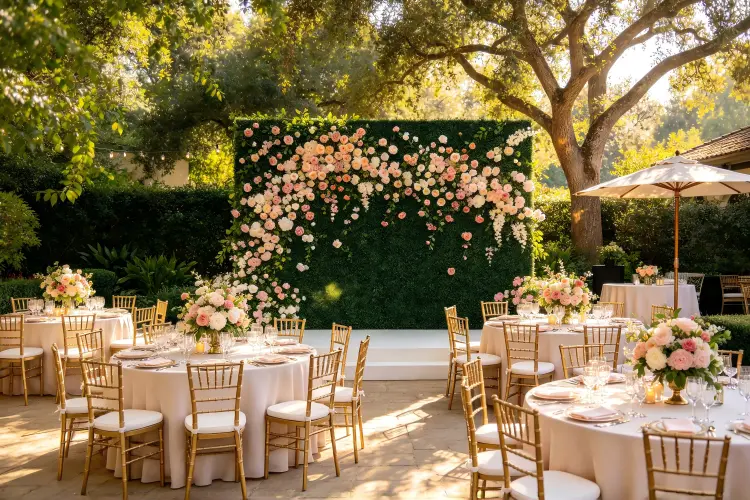
Here's what nobody tells you about outdoor artificial flower decor: the label on the box means less than you think. I've seen rental companies buy flower walls that say "UV resistant" and "outdoor safe," set them up for a garden wedding in June, and by September the panels are faded, brittle, and growing mildew on the backing. That's $2,400 of inventory turned into warehouse clutter in three months.
I know because we've had clients call us in a panic after exactly this happened. They bought from a supplier who slapped "UV protected" on the listing, charged them a premium, and delivered panels with a surface spray coating that washed off after two rainstorms. The flowers underneath? Basic polyester with zero UV stabilizer. Faded to a pale, sickly version of their original color by the end of summer.
The outdoor event market is where the real money is in 2027. Garden weddings, rooftop corporate events, patio brand activations — clients pay 20–40% more for outdoor setups because they're harder to execute. But you can only capture that premium if your inventory actually survives. This guide is built on what we've learned supplying 400+ rental companies, plus data from industry tests on material degradation. If you're buying outdoor flower walls, read this before you spend a dollar.
The 3 Enemies of Outdoor Artificial Flowers
Before we talk about solutions, you need to understand what actually destroys outdoor artificial flowers. There are three enemies, and they work together:
Enemy 1: UV Radiation — The Color Killer
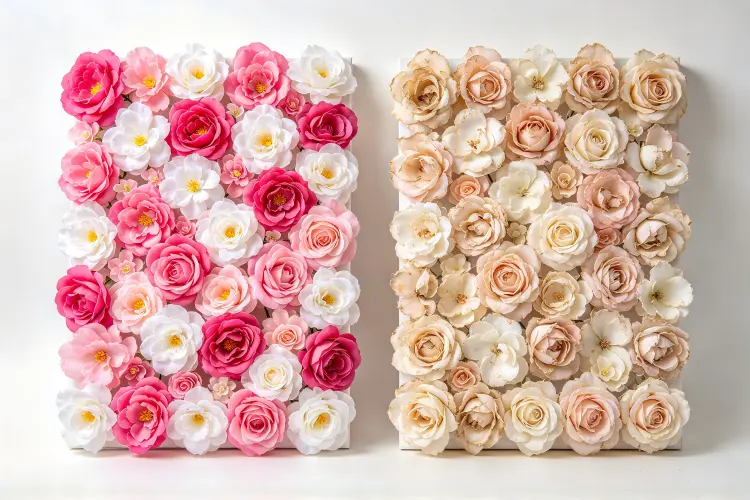
Ultraviolet rays from sunlight break down the polymer bonds in plastic and fabric. This isn't a surface issue — it's molecular. The dyes and pigments used to color artificial flowers are organic compounds, and UV radiation literally splits them apart. Result: fading. A vibrant blush pink becomes a washed-out peach. A deep burgundy turns into a dull mauve. According to material testing data, unprotected polyester flowers can lose 40–60% of their color intensity after 500 hours of direct sun exposure — that's roughly one summer season in most climates (Artificial Plants & Trees Co, 2026).
Enemy 2: Moisture — The Structure Killer
Rain, dew, and high humidity don't just make flowers wet — they get trapped in the backing material, the glue joints, and the wire stems. If the backing is fabric-based (which most flower walls are), moisture creates the perfect environment for mold and mildew. The Flower Wall Company explicitly warns that moisture can cause mold or mildew on backing material, and recommends avoiding use in rain or high humidity (The Flower Wall Company, 2026). Mold doesn't just look bad — it weakens the fabric backing and causes flowers to detach.
Enemy 3: Wind & Physical Stress — The Mechanical Killer
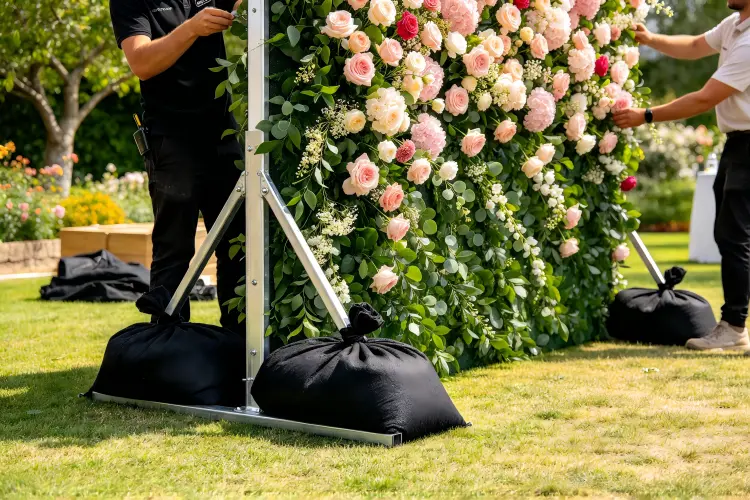
An 8ft×8ft flower wall is essentially a 20-pound sail. In a 15mph wind, that's enough force to tip over a standard stand. Wind also causes flexing — the panels bend back and forth, weakening the glue joints and causing flowers to pop off. The Outdoor Look advises keeping flower walls under cover at weddings specifically because "wind puts a tall backdrop at risk" (The Outdoor Look, 2026).
Here's the critical insight: these three enemies work together. UV radiation makes plastic brittle, which makes it more susceptible to wind damage. Moisture weakens glue joints, which makes flowers more likely to blow off. A flower wall that's only protected against one enemy will still fail — because the other two will get it.
What "UV Resistant" Actually Means (And What It Doesn't)
This is the most important section in this guide. The term "UV resistant" is the most misused label in the artificial flower industry. Here's what it actually means, layer by layer.
True UV protection is built into the material at manufacturing. UV stabilizers — chemical compounds that absorb or reflect ultraviolet radiation — are mixed into the plastic and polymer compounds before the flowers are molded or extruded. This is called "UV-inherent" or "UV-stabilized" material. The protection is throughout the entire thickness of the petal or leaf, not just on the surface. Even if the surface gets scratched or washed, the UV protection remains (Artificial Plants & Trees Co, 2026).
Surface coating is not the same thing. Many budget suppliers spray a UV-resistant coating onto finished flowers. This works for a while — maybe a few months — but rain washes it off, cleaning wipes it away, and eventually you're left with unprotected flowers underneath. Well Whisk's testing found that "premium options often use a plastic or silk-petal construction with UV-inhibitors mixed into the material itself, not just a surface coating that washes off" (Well Whisk, 2026).
| Label Term | What It Usually Means | What It Doesn't Guarantee | Rental Risk Level |
|---|---|---|---|
| UV-stabilized / UV-inherent | UV inhibitors mixed into the plastic compound during manufacturing | Waterproofing or mold resistance | Low — best option for outdoor |
| UV resistant / UV protected | Could be UV-inherent OR surface coating — ambiguous | Which method was used; coating durability | Medium — must ask for specifics |
| Outdoor safe / Outdoor use | Structure won't fall apart in rain; may have basic water resistance | UV color protection at all | High — color will likely fade |
| Weatherproof | Water-resistant construction; seams and backing treated | UV fading or long-term color stability | Medium-high — structure survives, color may not |
| Indoor/outdoor | Can be used outdoors occasionally, not designed for permanent exposure | Survival through a full outdoor rental season | High — fine for occasional use, not for regular outdoor rentals |
Source: Celestial At Home label analysis (2026), Well Whisk material testing (2026), Botanicblossoms outdoor display rules (2026), Xibo Floral client feedback from 400+ rental accounts.
The rule for rental companies: if a supplier can't tell you the exact UV inhibitor concentration and whether it's mixed into the material or sprayed on, assume it's a surface coating. Surface-coated flowers are fine for indoor use and occasional outdoor events — but if you're doing weekly outdoor rentals, you need UV-inherent material.
Material Comparison: What Lasts Outdoors?
Not all artificial flowers are created equal. The material determines everything about outdoor survival. Here's the breakdown:
| Material | UV Resistance | Water Resistance | Realism | Outdoor Lifespan | Cost Level |
|---|---|---|---|---|---|
| UV-stabilized PE (polyethylene) | Excellent — UV inhibitors in compound | Excellent — non-porous, dries fast | Good — molded texture | 3–5 years regular outdoor use | High |
| Molded plastic foliage | Very Good — solid plastic | Excellent | Good for greenery, less for flowers | 3–4 years | Medium-High |
| UV-coated polyester | Fair — coating washes off over time | Fair — fabric absorbs moisture | Very Good — soft petal texture | 1–2 years (coating fails first) | Medium |
| Silk / polyester silk | Poor — no inherent UV protection | Poor — absorbs water, stains easily | Excellent — most realistic | 3–6 months direct sun | Low-Medium |
| Foam flowers | Poor — yellows and crumbles | Poor — absorbs and retains water | Fair — artificial look | 2–4 months | Low |
Source: The Artificial Flowers Company material guide (2026), HomeToSight UV testing (2026), Botanicblossoms material analysis (2026), Xibo Floral factory production data.
The Artificial Flowers Company is blunt about this: "UV-treated PE or polyblend plastics tend to be the most resilient for genuine outdoor use, resisting fading and staying flexible the longest. Silk and polyester 'silk' flowers look beautifully realistic but are not designed for prolonged outdoor sun. Reserve these for indoor displays, porches and sheltered nooks" (The Artificial Flowers Company, 2026).
For rental companies: if 30%+ of your events are outdoors, invest in UV-stabilized PE flower walls. They cost 25–40% more upfront, but they last 3–5x longer outdoors. The math is simple: a $600 PE wall that lasts 4 years = $150/year. A $400 silk wall that lasts 8 months outdoors = $600/year. The cheaper wall is actually 4x more expensive per year of outdoor use.
UV-Stabilized Flower Walls at Factory-Direct Pricing
Our outdoor-grade flower walls use UV-inherent PE material — UV inhibitors mixed into the polymer compound, not sprayed on. Mold-resistant backing, rust-proof metal frames, and 7–10 day shipping. MOQ starts at 10 panels. Built for rental companies who do weekly outdoor events.
Request Outdoor-Grade Flower Wall Catalog5 Questions Rental Companies Must Ask Before Buying Outdoor Flower Walls
Don't trust the label. Ask these five questions before you buy. If the supplier can't answer them clearly, walk away.
Question 1: Is the UV protection mixed into the material or sprayed on as a coating?
Correct answer: "UV inhibitors are mixed into the PE/polymer compound during extrusion." Wrong answer: "We apply a UV coating" or "It's UV treated" (vague). Surface coatings wash off. Material-inherent protection lasts the life of the product.
Question 2: What is the backing material, and is it mold-resistant?
Correct answer: "Reinforced polyester fabric backing with anti-mold treatment" or "Waterproof PVC backing." Wrong answer: "Standard fabric backing" (untreated). The backing is where mold grows — it's hidden behind the flowers, so you won't see it until it's too late.
Question 3: What is the frame made of, and will it rust?
Correct answer: "Galvanized steel" or "Powder-coated iron" or "Aluminum." Wrong answer: "Iron frame" (no coating). Outdoor moisture causes uncoated iron to rust, and rust stains bleed through the fabric backing onto the flowers.
Question 4: Do you have test data or client feedback on outdoor durability?
Correct answer: Specific test results (e.g., "500 hours UV exposure, less than 5% color fade") or client case studies. Wrong answer: "It's very durable" (no evidence). A supplier who has real outdoor-grade product will have test data to prove it.
Question 5: What is the expected outdoor lifespan with regular weekly use?
Correct answer: A specific number (e.g., "3–4 years with proper care"). Wrong answer: "A long time" or "Many years." Vague answers mean they haven't tested it, or they know it won't last and don't want to commit to a number.
7 Protection Measures for Outdoor Setups
Even the best outdoor-grade flower wall needs proper installation. These seven measures will double the lifespan of your outdoor inventory:
| # | Protection Measure | What It Prevents | Implementation |
|---|---|---|---|
| 1 | Choose shaded or partially shaded location | UV fading, heat damage | Place under trees, awnings, or marquees; avoid direct south-facing sun (Botanicblossoms, 2026) |
| 2 | Secure stand with weights or sandbags | Wind tip-over, mechanical damage | Minimum 25lbs per leg; use sandbags or steel weight plates (The Flower Wall Company, 2026) |
| 3 | Elevate panels off wet ground | Backing mold, water wicking | Use frame with minimum 6-inch ground clearance; never place panels directly on grass or dirt |
| 4 | Avoid setup in forecasted rain | Mildew, glue joint failure | Check 48-hour forecast; have indoor backup location; use pop-up canopy if light rain expected |
| 5 | Apply UV protectant spray seasonally | Surface fading, dust accumulation | Krylon UV Floral Protectant or similar; reapply every 2–3 months of outdoor use (Botanicblossoms, 2026) |
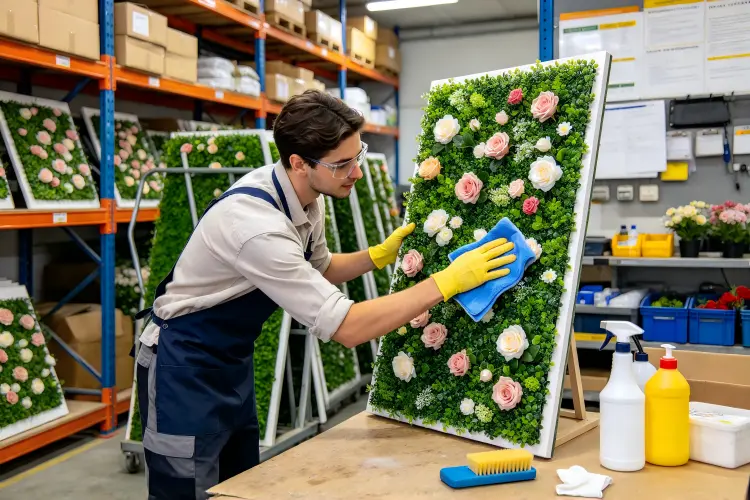
| 6 | Clean and dry panels after each outdoor event | Mold, mildew, staining | Wipe with damp cloth, air dry completely before storing; never store wet panels |
| 7 | Rotate panels between indoor and outdoor events | Accelerated UV degradation | Don't use the same panels for every outdoor event; rotate stock so no panel gets continuous sun exposure |
UV Spray: Does It Actually Work?
UV protectant sprays are the most commonly recommended "solution" for outdoor artificial flowers — and the most misunderstood. Let's be clear about what they can and cannot do.
What UV spray does: It adds a clear protective surface layer that reduces fading, moisture damage, dirt buildup, and discoloration. Products like Krylon Ultra UV Floral Protectant are specifically formulated for silk and dried flowers, and they do provide a measurable boost in UV resistance for coated materials (Botanicblossoms, 2026).
What UV spray does NOT do:
- It does not make flowers waterproof — "petals, seams, glue, stems, internal wire, foam, and flower centers may still allow water inside" (Botanicblossoms, 2026)
- It does not make flowers permanent or completely sun-proof — it slows fading, it doesn't stop it
- It does not fix already-faded flowers — prevention only, not restoration
- It does not replace UV-inherent material — a spray-coated silk flower will still fade faster than a UV-stabilized PE flower, even with regular reapplication
The honest assessment: UV spray is a maintenance tool, not a solution. If you have UV-stabilized PE walls, seasonal spraying extends their life. If you have silk or basic polyester walls, spraying helps but won't turn them into outdoor-grade products. Think of it like sunscreen for your flowers — it helps, but you still wouldn't leave a fair-skinned person in the sun all day.
Outdoor vs. Indoor Inventory: Should You Buy Separate Stock?
This is the strategic question. Should you buy separate outdoor-grade and indoor flower walls, or try to use one inventory for both?
If outdoor events are less than 15% of your bookings: Use your indoor inventory for outdoor events with heavy protection (shade, weights, UV spray, immediate cleaning). Accept that these panels will degrade faster and budget for replacement every 18–24 months. Don't buy separate outdoor stock yet.
If outdoor events are 15–30% of your bookings: Buy 1–2 outdoor-grade walls (UV-stabilized PE) for your most frequent outdoor setups. Use indoor walls for occasional outdoor events. This gives you a reliable outdoor option without doubling your inventory cost.
If outdoor events are 30%+ of your bookings: Maintain separate outdoor and indoor inventory. Outdoor-grade PE walls for all outdoor events. Indoor silk/polyester walls for indoor events. The outdoor walls will pay for themselves through higher rental prices (20–40% premium for outdoor setups) and longer lifespan (3–5 years vs 6–12 months for indoor walls used outdoors).
Yingsheng Wedding Decor's ROI analysis confirms this: "Outdoor garden parties and rooftop venues are where the real money is in summer. UV-treated materials won't yellow after six months of storage. Wipe-clean surfaces mean a spilled champagne flute doesn't end a panel's career. Over 50 rentals, these details are the difference between a product that pays for itself and one that depreciates into a write-off" (Yingsheng Wedding, 2026).
5 Costly Outdoor Flower Wall Mistakes
Mistake 1: Trusting the "UV resistant" label without asking how
The #1 mistake. "UV resistant" could mean UV-inherent material or a surface spray — there's no industry standard definition. Always ask: "Is the UV protection mixed into the material or sprayed on?" If the answer is vague, assume coating. Coating washes off. Material-inherent lasts.
Mistake 2: Using indoor silk walls for regular outdoor rentals
Silk flowers look the most realistic, which is why they're tempting. But they have zero inherent UV protection and absorb water. A silk wall used weekly outdoors will fade and mold in 6–12 months. That's $400–$800 of inventory gone in a season. Use silk for indoor only.
Mistake 3: Skipping weights on the stand
I've seen a $600 flower wall tip over in a 12mph gust because the setup crew didn't bring sandbags. The frame bent, 15 flowers popped off, and the backing tore. Minimum 25lbs per leg. Always. No exceptions. Wind doesn't care about your event timeline.
Mistake 4: Storing panels wet or damp
You finish an outdoor event, it rained a little, you pack the panels in the truck, and you don't open them until next week. By then, mold is growing on the backing. Always air-dry panels completely before storing. This is the #1 cause of mildew in rental inventory.
Mistake 5: Not rotating outdoor panels
If you use the same 4 panels for every outdoor event, they'll fade 3–4x faster than if you rotate through 8–10 panels. Rotation distributes UV exposure across your inventory. It's the same principle as rotating tires on a car — even wear = longer total life.
FAQ
Build an Outdoor Inventory That Actually Lasts
Stop replacing faded, moldy flower walls every season. Our UV-stabilized PE outdoor-grade walls are built for weekly outdoor rentals — UV inhibitors in the material, mold-resistant backing, rust-proof frames. Factory-direct pricing, 7–10 day shipping, MOQ 10 panels. Tell us your outdoor event percentage and we'll recommend the right inventory mix.
Browse Outdoor-Grade Flower Walls