Red White Crescent Flower Arch – Moon Gate Wedding Arch
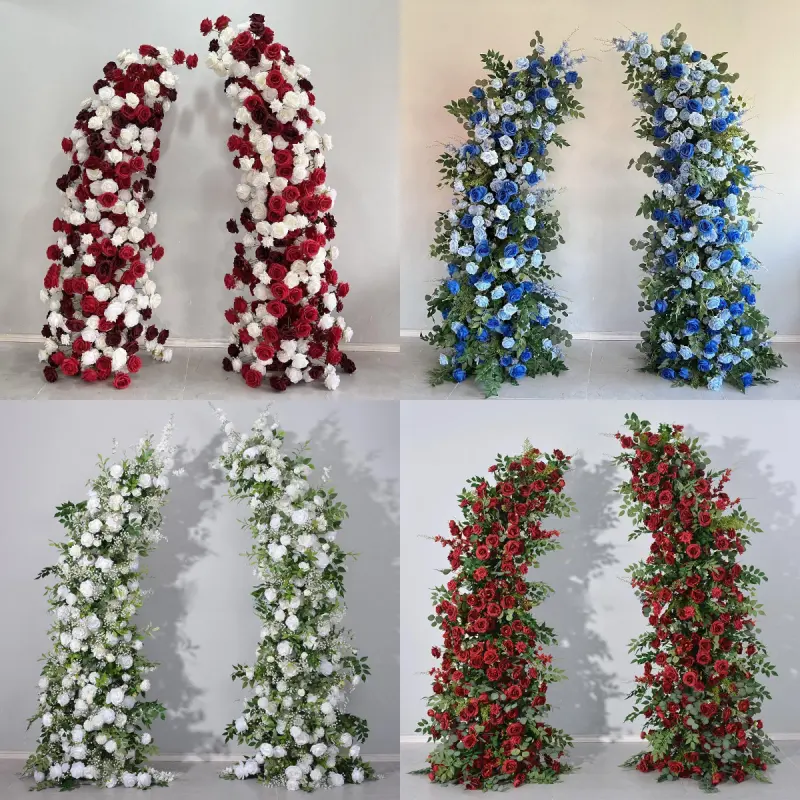
Asymmetric Red and White Rose Crescent Floral Arch with Burgundy Accent – Bold Romantic Moon Gate Wedding Arch with Metal Frame Included for Classic and Dramatic Ceremonies
Red is the hardest color. Not because it's expensive. Because it lies.
A wedding planner from Chicago called me last winter. She wanted a red and white crescent arch for a classic winter wedding. "Bold red, clean white, nothing in between," she said. I wrote it down. Red. White. Crescent. We made it. Shipped it. She set it up. Called me back. "This isn't the red I wanted," she said. "It's orange."
I looked at the photos. She was right. In the hotel ballroom – warm tungsten lights, gold chandeliers – our red roses looked orange. Not bold red. Orange. The kind of orange that makes a wedding planner's stomach drop. The kind of orange that means "the florist messed up."
Here's the thing about red silk flowers. They look red in our factory. Our factory has white LED lights. Cold, bright, neutral. Red looks red. But put that same flower under warm hotel lighting – 2700K bulbs, gold tones, dimmer switches – and the red shifts. It warms up. It turns orange. Or sometimes pink. Or sometimes a weird brownish-red that nobody wants. White doesn't do this. White stays white. Red lies.
We fixed the Chicago order. Remade the flowers with a deeper, cooler red base. Shipped new ones. She was happy. But I kept thinking about it. How many other red arches had we shipped that looked orange in someone's ballroom? How many planners had set up our red arch and thought "this isn't right"? We didn't know. Nobody had complained before. Maybe they just didn't reorder.
So we changed how we check red. Now every batch of red flowers goes through what we call the three-light test. Natural daylight first. Then warm 2700K hotel light. Then cool 5000K office light. If the red looks different enough to matter in any of the three, the batch gets rejected. About 15% of red flower batches fail this test. White? About 6%. Red is harder. Red lies.
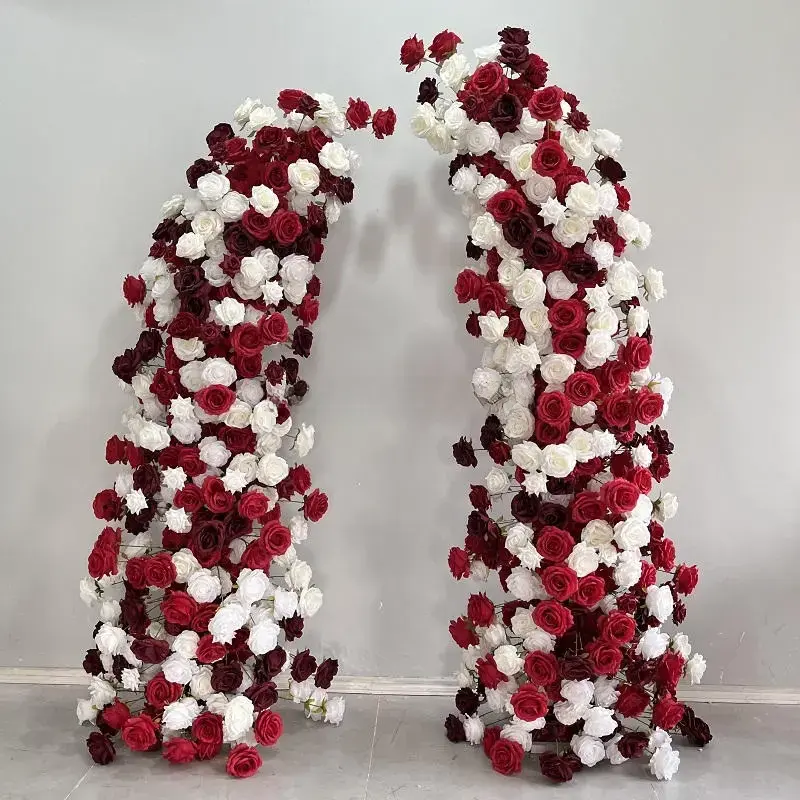
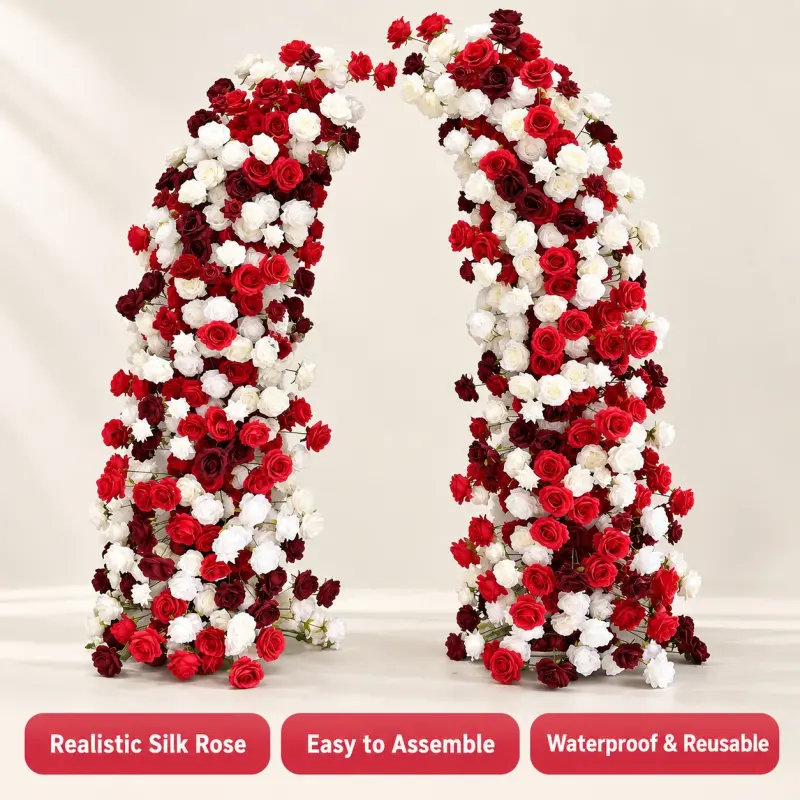
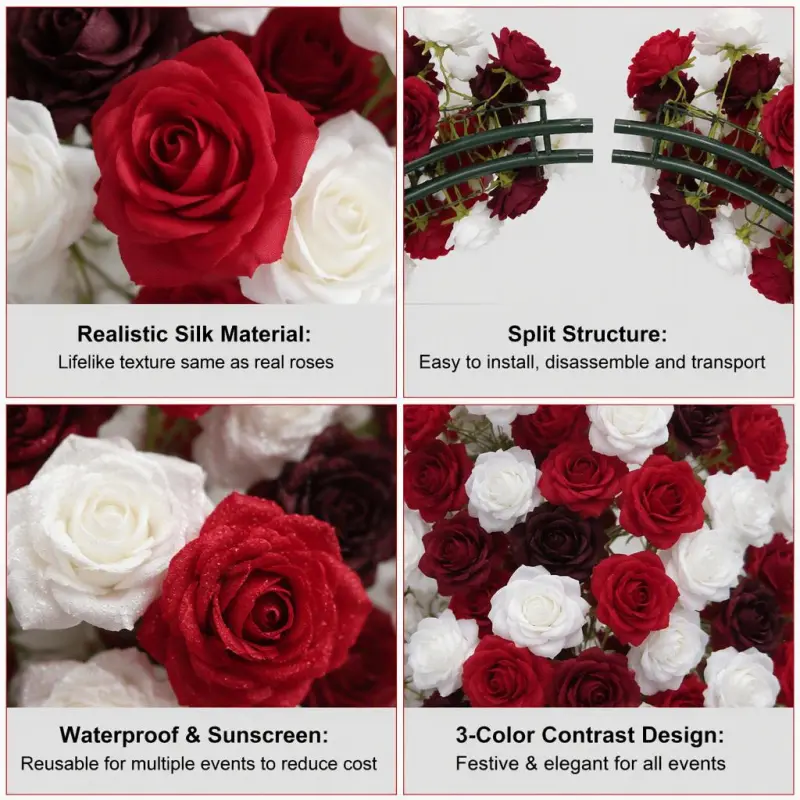
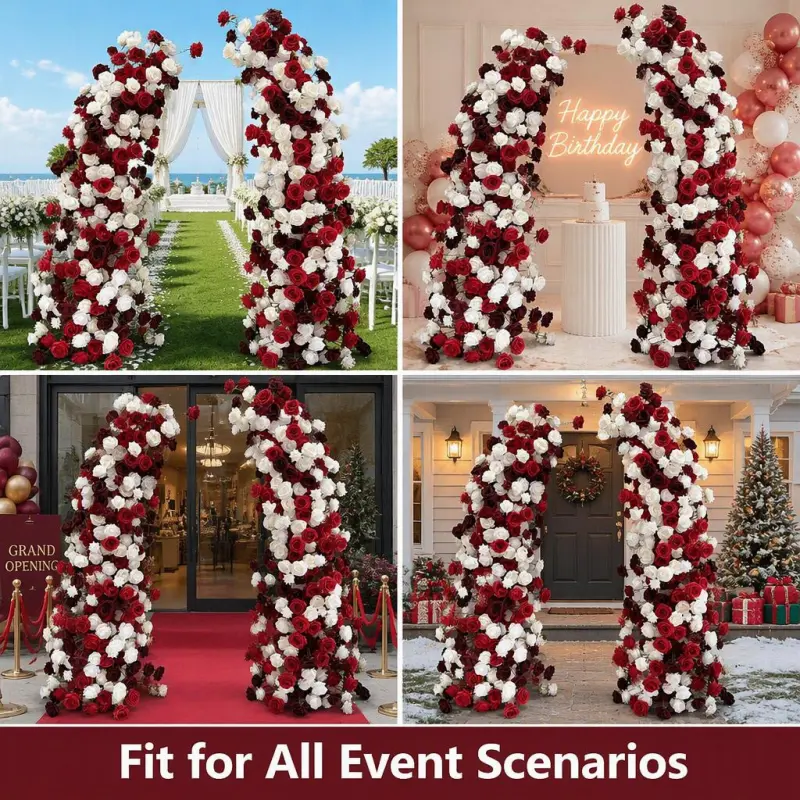
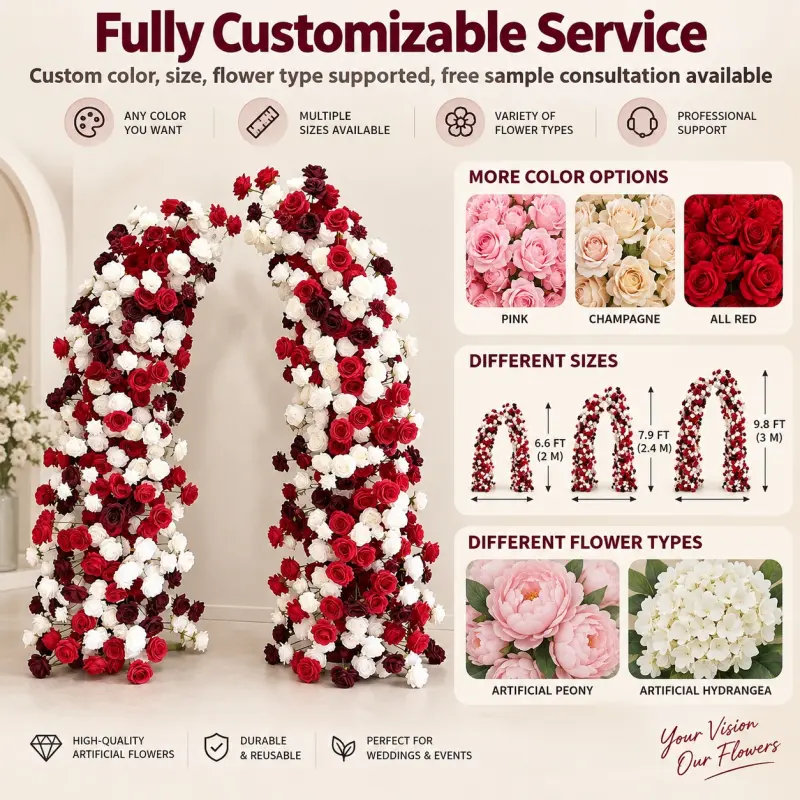
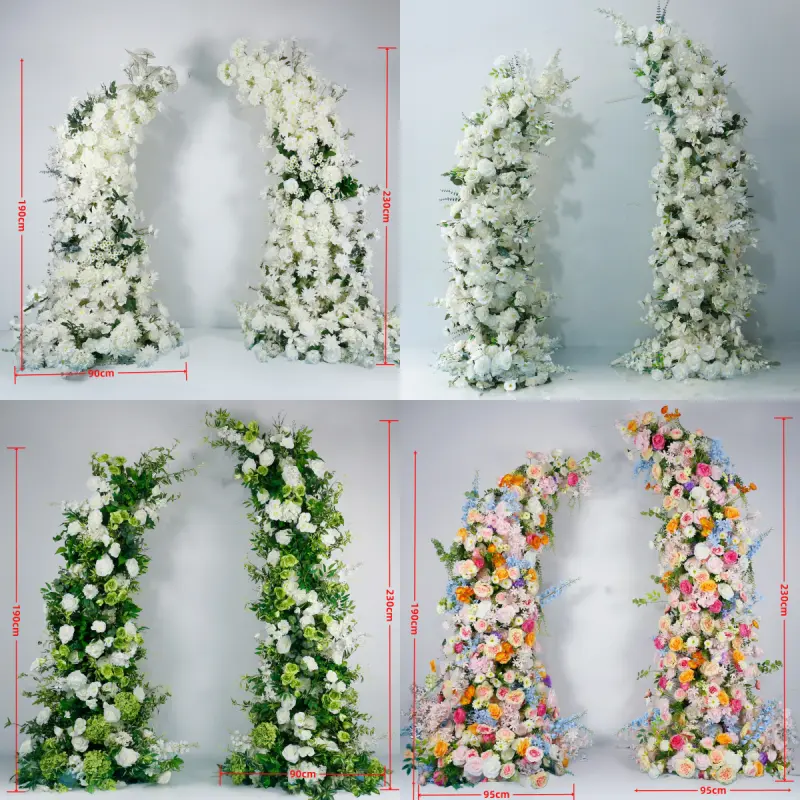
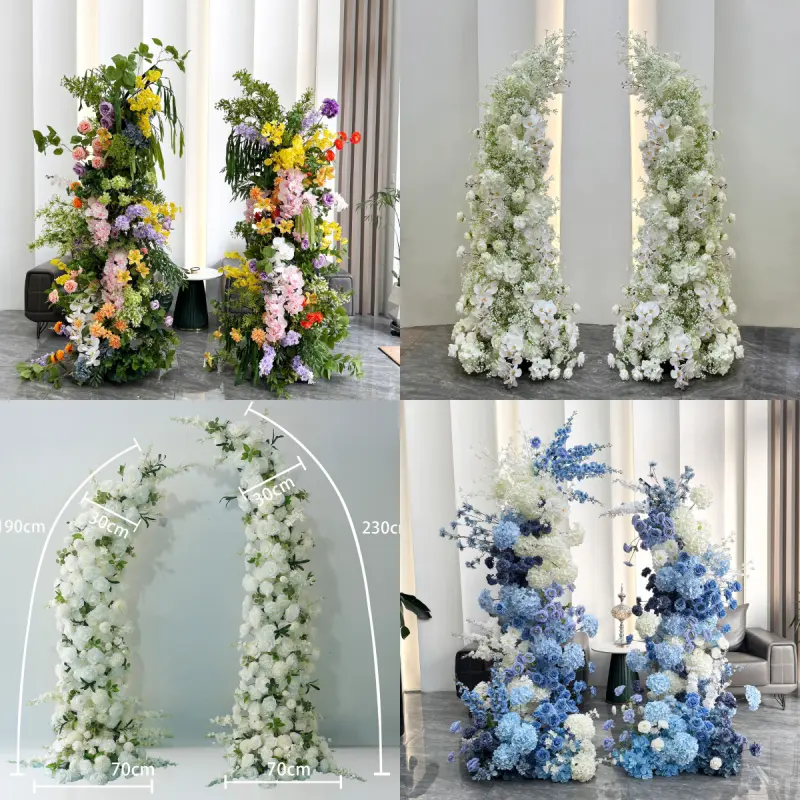
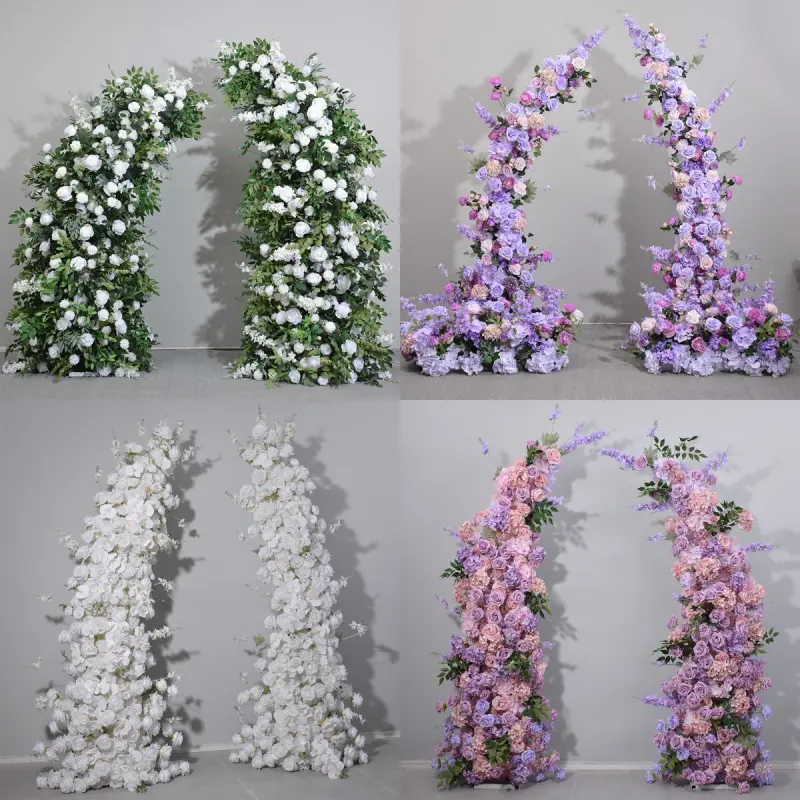
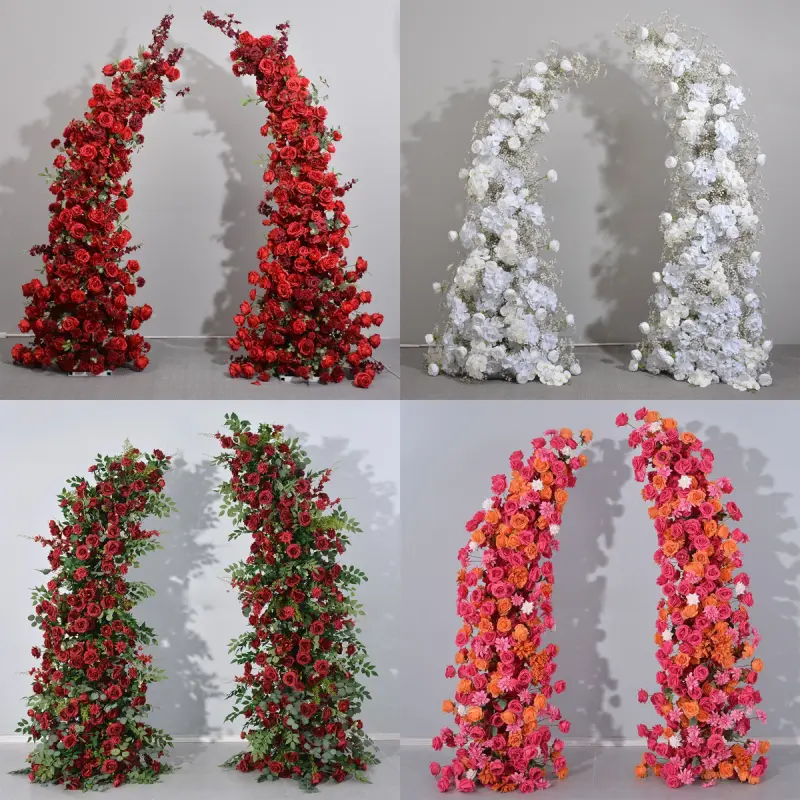
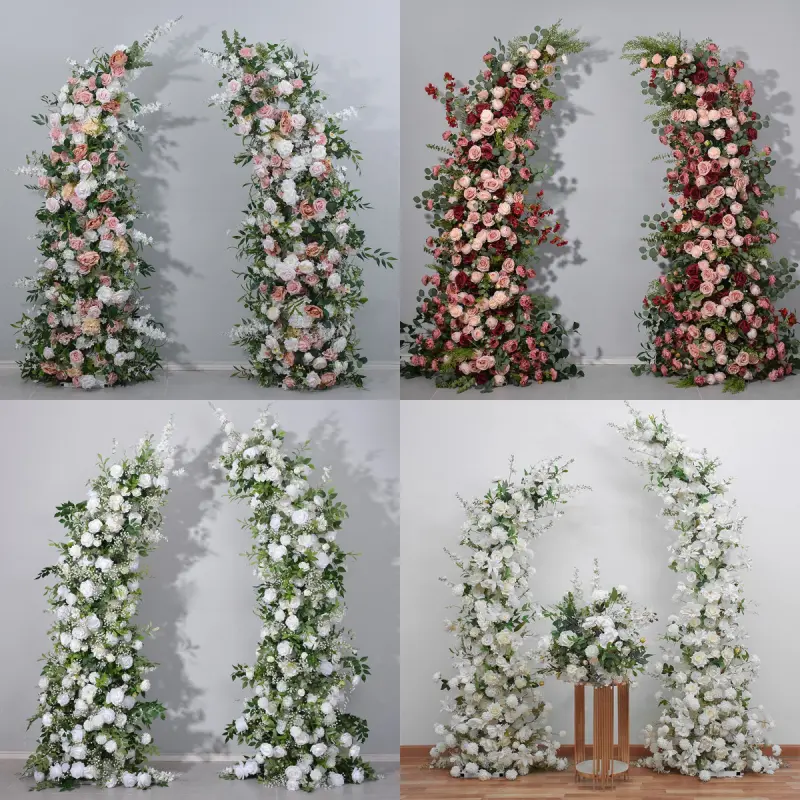
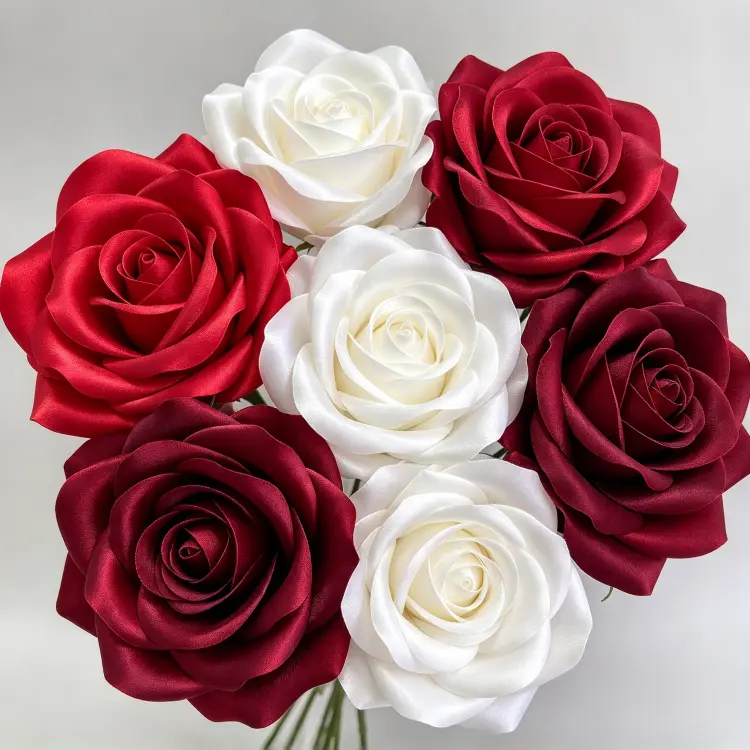
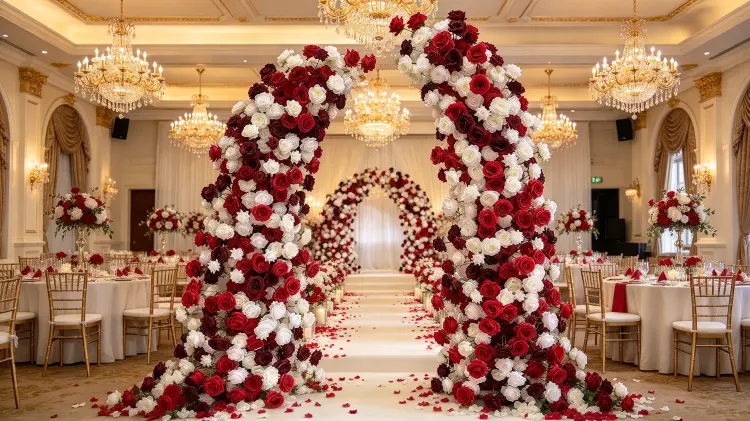
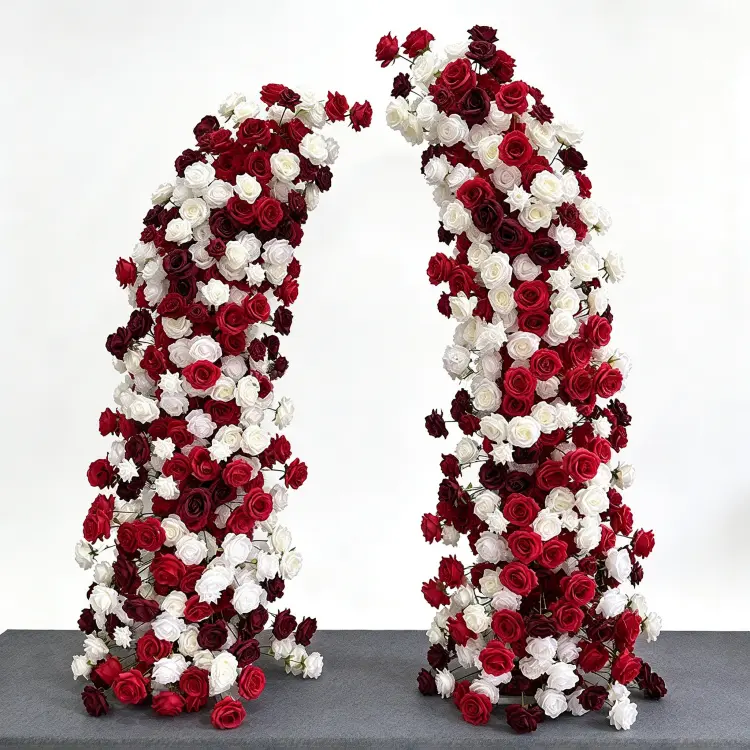
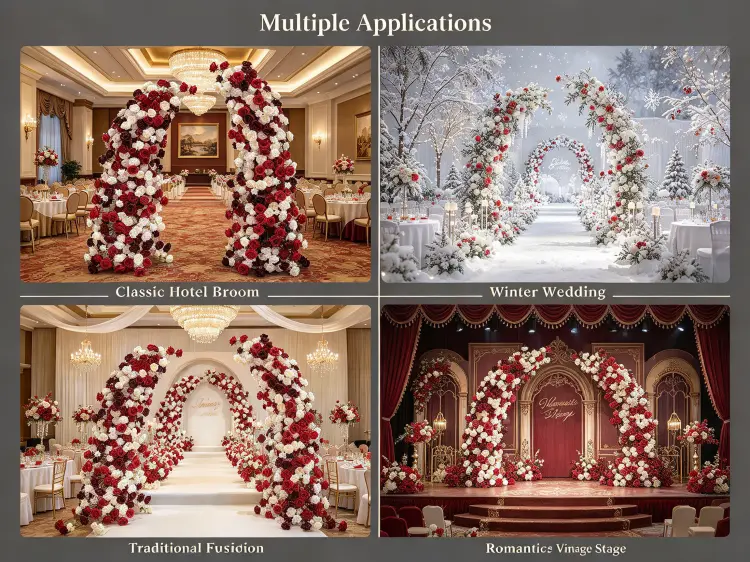
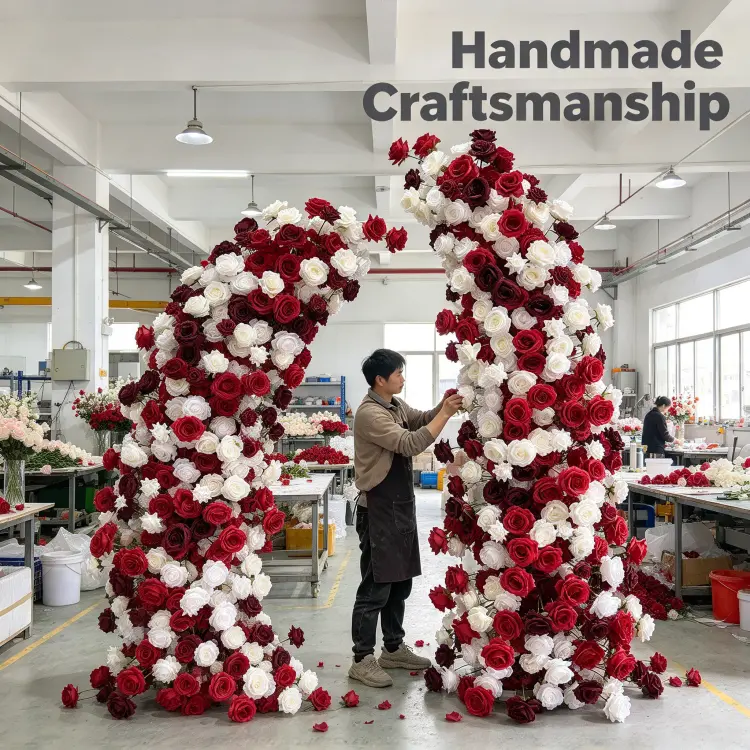
This is our red and white crescent arch. White roses, true red roses, burgundy roses as the transition color. The burgundy is important. Without it, red and white clash. Too much contrast. The eye bounces. With burgundy in between, the red deepens into the white. It looks intentional. It looks classic. It looks like someone thought about the color, not just dumped red and white together.
The ratio is roughly 40% red, 40% white, 20% burgundy. But visually, the red reads as more because red is louder. That's the trick. You don't need as much red as you think. If you use 50% red, it looks like a Valentine's Day decoration. 40% red with burgundy transition? It looks like a wedding. I learned this the hard way. The Chicago planner learned it with me. She's ordered three more red-white crescents since then. All pass the three-light test. All look red, not orange.
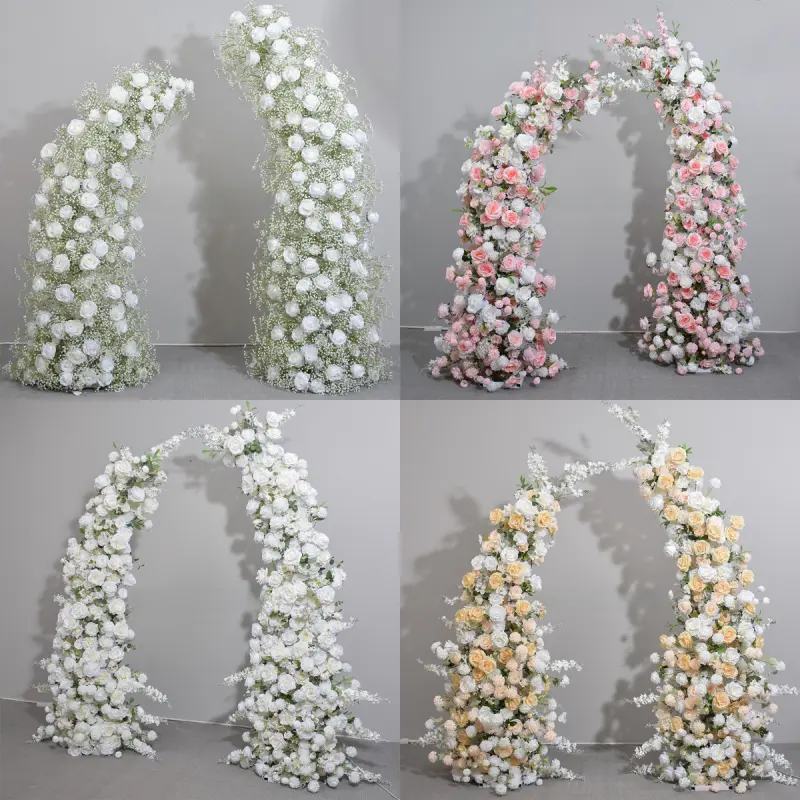
Crescent shape. Not U-shaped. The two columns curve inward at the top, leaving an opening. Some people call it a moon gate. Some call it a horn arch. We call it crescent. For red and white, the crescent shape works better than U-shape because the asymmetry breaks up the color. On a symmetric U-arch, red on one side and white on the other looks like a flag. On a crescent, the colors blend along the curve. It looks designed. Not patriotic.
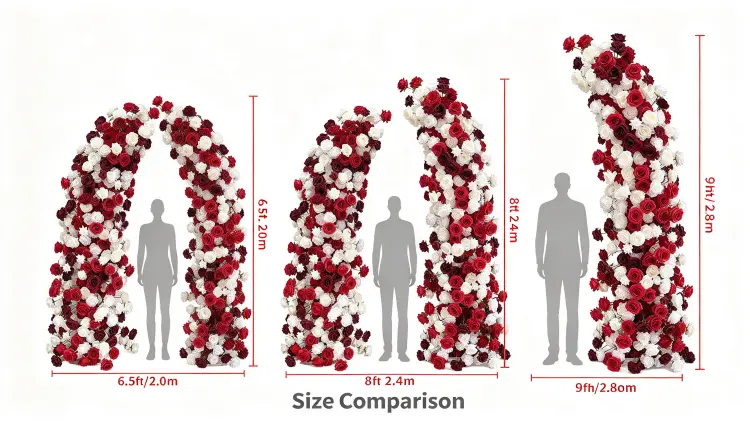
8 feet tall at the highest point. We do 6.5 and 9 too. But 8ft is where the crescent shape reads best. At 6.5ft, the curve is too tight. At 9ft, the red gets lost at the top because people look at eye level. 8ft is the sweet spot for red-white. I've made enough of these to know. I've also made enough wrong ones to know what wrong looks like. Orange is wrong.
What's on this arch? Red roses – both fully bloomed and buds. White roses – same. Burgundy roses – the transition color. That's three rose types. No peonies, no baby's breath, no eucalyptus. Red and white crescents don't need filler flowers. The color contrast is enough. Adding greenery would dilute it. Adding baby's breath would make it look busy. Three rose types. That's it. Fewer flowers types, more impact. For red-white, anyway. White crescents need five types. Colored crescents can handle six or seven. Red-white is three. The colors do the work.
The balance check still applies. Same as every crescent. Stand back. Look. Add a flower here. Remove one there. But red-white crescents have an extra check: the color balance. You can't have too much red on one side. The eye reads red as heavier. So we actually put slightly more white on the red-heavy side to compensate. It sounds wrong. It works. Mei – our QC person – says "red weighs more." She's been doing this 11 years. I don't argue with her about balance. She's right more than I am.
Both sides dense. Top dense. No bare metal. The hand test applies. The balance test applies. The three-light test applies. That's three tests for red-white crescents. White crescents get two. Red-white gets three because red lies. About 1 in 8 crescent arches fails the balance test. About 1 in 7 red-white crescents fails the three-light test after the flowers are tied on. Sometimes a flower that passed the batch test looks different once it's next to white and burgundy. Color is like that. It changes depending on what's next to it.
What I tell people who ask about red-white vs all-white: All-white is safe, modern, minimalist. Red-white is bold, classic, romantic. If your wedding is traditional, formal, or has a red accent color (invitations, bridesmaid dresses, table settings), red-white works. If it's modern, minimalist, or neutral palette, all-white. Also – red-white photographs differently in different lighting. Tell your photographer. They'll adjust white balance. If they don't, the red might look orange in the photos. We fixed the flowers. The photographer has to fix the camera.
What Matters About This Arch
Three-light color test
Every red flower batch checked in natural light, warm 2700K hotel light, and cool 5000K light. If it shifts to orange or pink in any setting, the batch is rejected. About 15% fail. Red lies under warm light. We catch it before it ships.
Burgundy transition, not clash
Red and white side by side can look like a flag. Burgundy roses between them create a gradient – red deepens into burgundy, burgundy softens into white. 40% red, 40% white, 20% burgundy. Looks intentional, not accidental. The ratio matters.
Asymmetric, not lopsided
Crescent shape means intentional asymmetry. We balance visual weight, not flower count. Red reads as heavier, so we compensate with slightly more white on red-heavy sections. About 1 in 8 fails the balance check. Red-white fails slightly more because color adds another variable.
Frame in the box
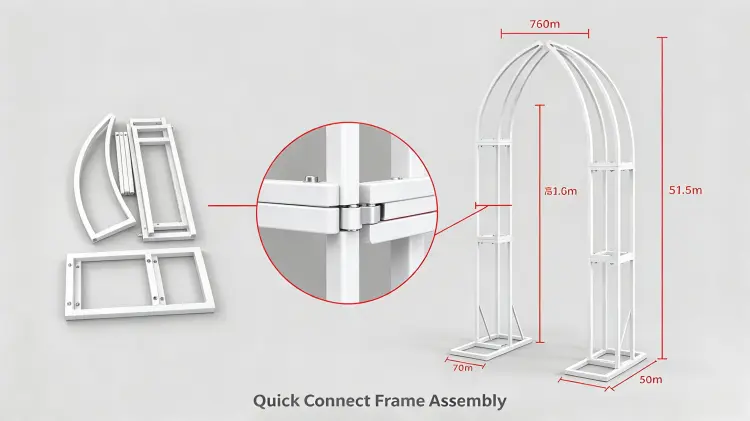
Always. Since 2020. Three pieces. Ten minutes. No tools. Powder coated dark bronze for red-white arches – white frame would show through gaps, black is too harsh. Dark bronze disappears between the flowers. I mention this in every product. People still ask. I get it.
How We Actually Make It
🏭 Factory Breakdown – Red White Crescent Arch
Frame
25mm iron tube, 1.5mm wall, bent on a custom crescent jig. Same jig as all crescents. Powder coated dark bronze – not white, not black. Dark bronze is the invisible frame color for red-white. White frame shows through every gap. Black frame creates harsh shadows. Dark bronze just disappears. Our welder Zhao – 9 years – says bronze coating is "the polite color." I don't know what that means. He's usually right about frames.
Flowers
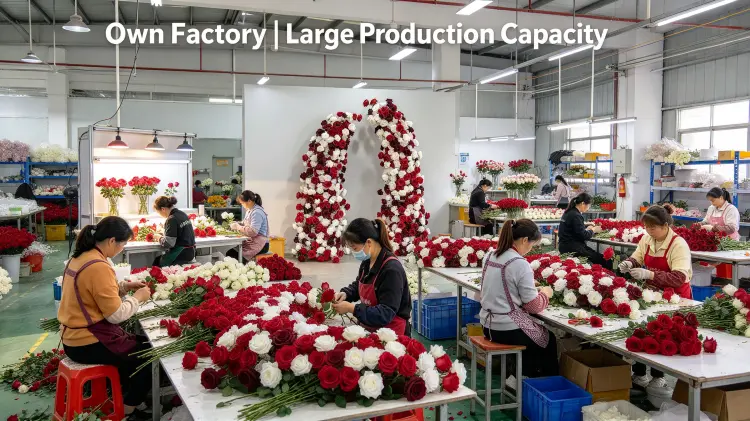
Red roses, white roses, burgundy roses. Three types. Red goes through the three-light test – natural, warm 2700K, cool 5000K. About 15% of red batches fail. White gets the yellowing check – about 6% fail. Burgundy is the most stable color – almost never fails, which is why we use it as the transition. Sister Li runs the dyeing department. 14 years. She says "red is the most dishonest color." I've stopped arguing with her about colors. She's right. Red is dishonest.
Tying
Red-white crescents take longer than white. Not because there are more flowers. Because of the color placement. The tying team works in sections: red zone, transition zone, white zone. Then they step back. Check the color balance. Adjust. A Luxury red-white crescent takes about 8.5 hours. A Luxury white crescent takes about 8. The extra 30 minutes is all color checking. Nobody counts the minutes. They just know red-white days are longer. And more frustrating. Because if the color looks wrong, you have to untie and retie.
QC
12 check points. Plus the hand test. Plus the balance test from 5 meters. Plus the three-light test. Plus checking from three angles (front, left 45°, right 45°). Red-white crescents have the highest QC rejection rate of any crescent color: about 1 in 7. White is 1 in 8. Red-white is 1 in 7 because color adds another failure mode. Wang Lei runs QC for colored arches. 8 years. He built the three-light test station himself. Three light boxes, one switch. He says "red doesn't get to lie on my watch." I like that.
Packing
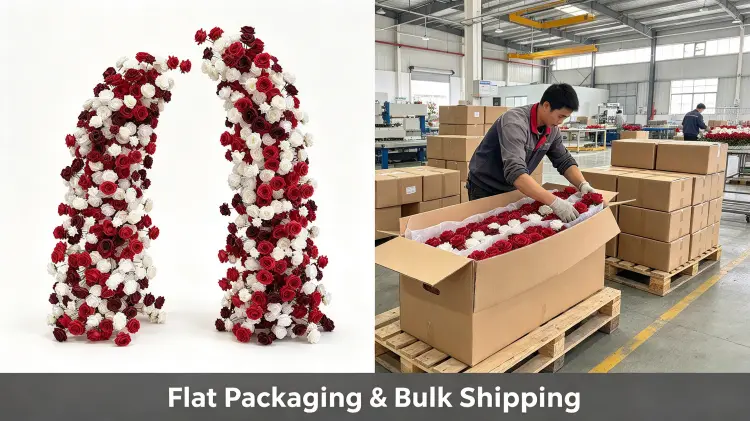
Frame comes apart in three pieces. Carton: 130×30×25cm. Same as all crescents. Red flowers are more prone to color transfer in shipping – red dye can rub onto white flowers if they're pressed together. So we put a thin tissue layer between red and white sections in the carton. Extra step. About 2 minutes per arch. Red-white damage rate about 4% – slightly higher than white's 3% because of color transfer. The tissue helps. Doesn't eliminate.
The Chicago wedding, full story: Winter 2025. Planner wanted a bold red and white crescent for a classic hotel wedding. We made it with our standard red. She set it up. Called back. "It's orange." I looked at the photos. She was right. Warm hotel lights turned our red orange. We remade the entire arch with a deeper, cooler red base. Shipped new ones overnight (we paid for the shipping). She was happy. But I couldn't stop thinking: how many other red arches had we shipped that looked orange in warm light? Nobody had complained. Maybe they just didn't reorder. So Wang Lei built the three-light test station. Now every red batch gets checked in three lighting conditions before it reaches the tying floor. About 15% fail. The Chicago planner has ordered three more red-white crescents. All pass. She calls our red "the honest red." I keep her first email in a folder labeled "red lessons." There are 6 emails in there. Each one taught me something about color. The subject line of the first one: "This isn't red." Answer: you're right. It was orange. We fixed it.
Pricing – Per Piece
3 Sizes × 3 Quality Tiers
Frame included. MOQ 1 piece. Red-white uses three rose types with burgundy transition and three-light color testing, but costs the same as other crescent colors.
2.0m (6.5ft)
$198
Standard / from
2.4m (8ft)
$268
Standard / from
2.8m (9ft)
$358
Standard / from
| Size \ Quality |
Standard |
Premium |
Luxury |
| 2.0m (6.5ft) |
$198 |
$248 |
$298 |
| 2.4m (8ft) |
$268 |
$328 |
$398 |
| 2.8m (9ft) |
$358 |
$428 |
$518 |
Which quality for a red-white crescent? I recommend Premium. Standard is fine for background decor. But red-white is a bold color combination – people notice it. They walk up to it. They touch the flowers. They take close-up photos. A Standard red-white can look slightly thin at the curve points, and thin spots show more on red-white than on any other color because the contrast makes gaps visible. Premium eliminates that. If it's a backdrop that nobody approaches, Standard works. If people will stand under it – and with a red-white crescent, they always will – get Premium. I own this company and I'd buy Premium for red-white. That's not upselling. That's experience. Red is unforgiving. White is unforgiving. Red-white is doubly unforgiving. The burgundy transition helps. But density helps more.
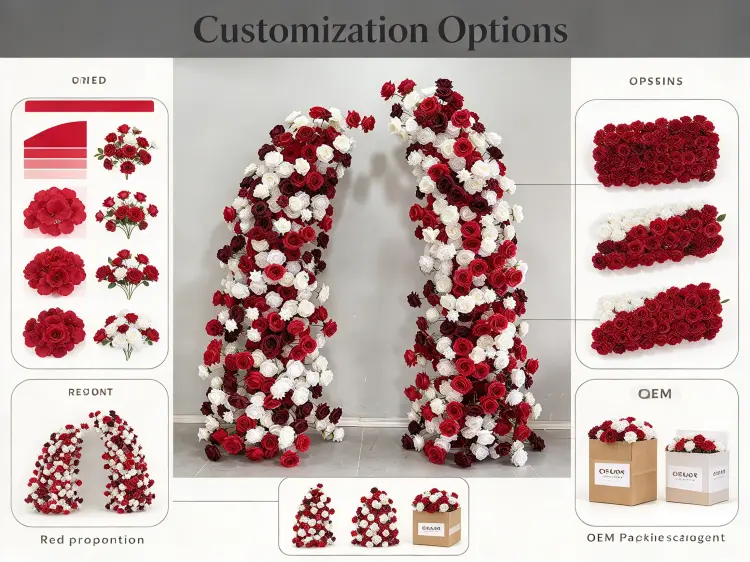
Custom red shades: We can adjust the red – deeper crimson, brighter scarlet, softer rose. We can adjust the white – pure white, ivory, cream. We can adjust the burgundy ratio. MOQ 2 pieces for custom colors, 20-25 days lead time. Send us a color swatch or reference photo. We'll match it. And it will still go through the three-light test. Always. Custom red doesn't skip the test. If anything, custom red gets extra testing because we don't have a baseline.
Where Red White Crescent Arches Actually Get Used
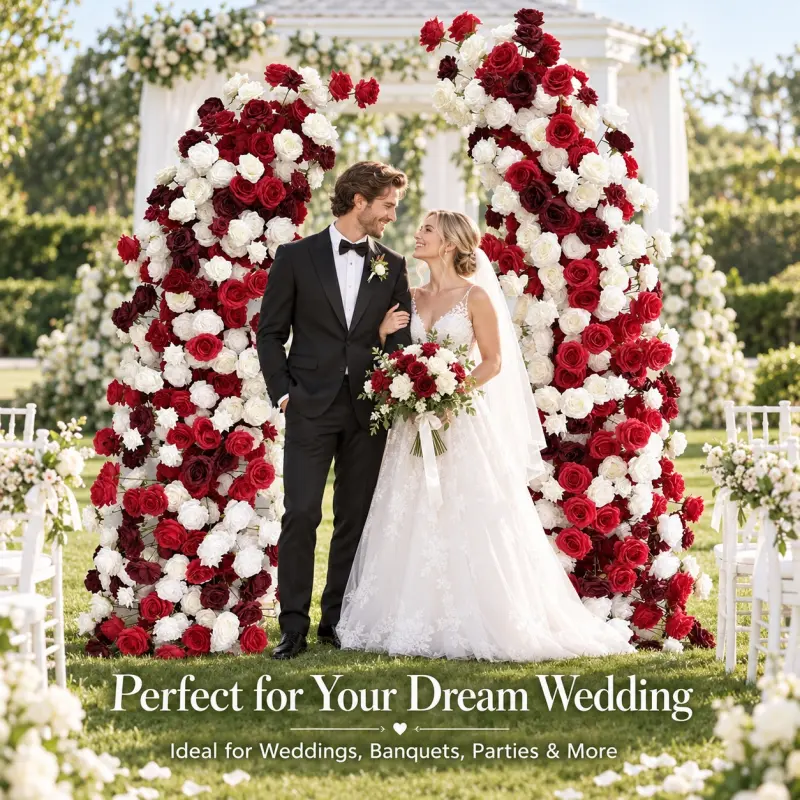
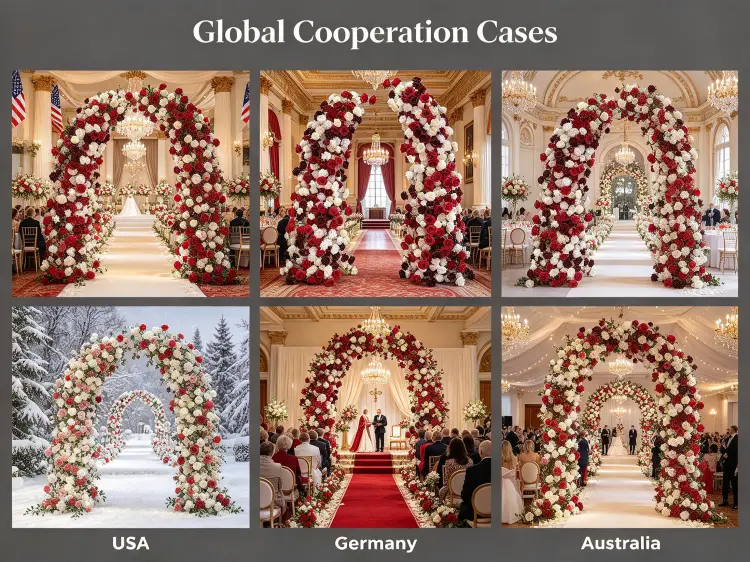
- Classic and traditional weddings – Red is the color of love, tradition, celebration. White is purity. Together they're the classic wedding color combination. We did 23 red-white arches for traditional weddings last year. I know because the planners all mention "classic" or "traditional" in their first email.
- Winter and holiday weddings – Red and white feels festive without being Christmas. Add some evergreen and it's holiday. Keep it just roses and it's wedding. Planners tell me red-white is their go-to for December through February weddings. I believe them. Our red-white orders spike in Q4.
- Hotel ballroom ceremonies – The crescent shape frames the ballroom architecture. Red-white pops against neutral ballroom walls. But – and this is important – make sure your hotel has warm or neutral lighting. Cool blue LED lights will make the red look purple. We test for warm and neutral. We can't test for your hotel's specific LEDs. Bring a swatch to the venue.
- Chinese and Asian fusion weddings – Red is the traditional wedding color in Chinese culture. White is increasingly accepted as a modern complement. The crescent shape adds a modern Western element to a culturally traditional color palette. We've shipped several red-white crescents to Chinese-American weddings. They tell us it's "the best of both." I take their word for it.
- Engagement parties and rehearsal dinners – Red-white feels celebratory. Not as formal as a full wedding ceremony. People take a lot of photos. The asymmetric crescent makes photos more interesting than a standard round arch. Planners send me the photos. I have a folder labeled "red-white photos." It's getting full.
- Rental companies – They tell us red-white crescents rent for 15-20% more than white crescents. Because red-white is bolder. Because it's a specific color request. Because "red and white" sounds more intentional than "white." One rental company in Chicago told me their red-white crescent has the highest booking rate of any colored arch in their inventory. I don't know if that's universally true. He had a spreadsheet. I believed him. He's the Chicago planner's rental partner. Small world.
Specs
| Item |
Detail |
| Product Name |
Red White Crescent Flower Arch – Moon Gate Wedding Arch |
| Shape |
Crescent / Moon Gate / Asymmetric curved arch (not U-shaped) |
| Sizes |
2.0m (6.5ft) / 2.4m (8ft) / 2.8m (9ft) / Custom |
| Flower Types |
Red roses (bloom + bud), white roses (bloom + bud), burgundy roses (transition color) |
| Color Ratio |
~40% red, ~40% white, ~20% burgundy (burgundy creates smooth color transition) |
| Flower Count (8ft Luxury) |
~220 flowers (three rose types, no filler flowers needed for red-white) |
| Color Testing |
Three-light test: natural daylight, warm 2700K, cool 5000K. ~15% red batches rejected for color shift |
| Frame |
25mm iron tube, 1.5mm wall, custom bent asymmetric curve, powder coated dark bronze, 3 pieces |
| Assembly Time |
~10 minutes, no tools |
| Weight |
10-17kg depending on size and quality |
| Packaging |
Disassembled flat, 130×30×25cm carton, tissue layer between red and white sections to prevent color transfer |
| MOQ |
1 piece (standard sizes), 2 pieces (custom colors/shapes) |
| QC Rejection Rate |
~14% (1 in 7) – highest of any crescent color due to three-light test + balance check |
| Factory |
Henan Xibo Flower Art Co., Ltd. – 4000㎡, 15 years, Zhengzhou China |
Customization
| Level | What's Included | MOQ | Lead Time |
|---|
| Stock Colors | 15+ stock colors including red-white, any size/quality, crescent shape as shown | 1 piece | 7-15 days |
| Custom Color | Pantone matching for red/white/burgundy shades, custom flower mix, adjust color ratio | 2 pieces | 20-25 days |
| Custom Shape | Adjust curve openness, asymmetry degree, height difference, full custom frame bend | 2 pieces | 25-30 days |
| Full Custom | Custom mix, size, shape, density, frame color, branded packaging | 5 pieces | 25-35 days |
Questions People Actually Ask
Will the red look orange in my venue's lighting?
That's exactly why we do the three-light test. Every red batch is checked in natural light, warm 2700K hotel light, and cool 5000K light. If it shifts to orange in any of those, we reject it. About 15% fail. But – and this is important – every venue is different. If your venue has unusual lighting (colored LEDs, neon, very warm or very cool), send us a photo or bring a flower swatch to the venue. We can adjust the red base to compensate. We can't test for every possible lighting condition. We test for the three most common. That catches most problems. Not all.
What's the red to white ratio? Can I change it?
Standard is about 40% red, 40% white, 20% burgundy. The burgundy is the transition color – without it, red and white clash. If you want more red, we can do 50/30/20. More white? 30/50/20. But I'll be honest: 40/40/20 is the sweet spot. More than 50% red starts to look like a Valentine's decoration. Less than 30% red and the arch reads as white with red accents, not red-white. Custom ratios are available with MOQ 2 pieces. We'll make a sample section first so you can see the ratio before we make the full arch.
Is this arch suitable for outdoor weddings?
Yes, but with caveats. The frame is powder coated iron – it can handle outdoor use. The flowers are UV-stabilized silk – they'll last 2-3 years outdoors before noticeable fading. Red fades faster than white in direct sunlight. If your outdoor ceremony is in full sun for hours, the red might slightly fade after multiple uses. For a one-day event, no problem. For rental use outdoors, expect to replace red flowers after 15-20 uses. White lasts longer outdoors. We also recommend weighting the base for outdoor use – the crescent shape has a higher center of gravity than a U-arch. We include base stakes for outdoor use.
Will the red dye rub off on the white flowers during shipping?
It can. That's why we put a thin tissue layer between red and white sections in the carton. Red dye transfer is more common in humid conditions or when the carton is compressed. Our damage rate for red-white is about 4% – slightly higher than white's 3%. If you receive an arch with color transfer, send us a photo within 48 hours. We'll send replacement white flowers free. It's usually just a few flowers. Easy to swap. The tissue layer prevents most of it. Doesn't eliminate all of it. Humidity is tricky.
What's the difference between crescent and U-shaped for red-white?
On a symmetric U-arch, if you put red on one side and white on the other, it looks like a flag. Half red, half white. On a crescent, the asymmetric curve means the colors blend along the slope. Red at the bottom, burgundy transition in the middle curve, white at the top. It looks like a gradient, not a division. That's why we recommend crescent for red-white. If you want a U-arch in red-white, we can do it, but we recommend mixing the colors throughout rather than splitting them. The crescent shape does the mixing for you.
Does the frame come with it? What color is it?
Yes. Three pieces. Ten minutes. No tools. For red-white arches, the frame is powder coated dark bronze. Not white – white frame shows through every gap. Not black – black creates harsh shadows between flowers. Dark bronze is the invisible frame color. It disappears between red and white roses. I mention this in every product. People still ask. I get it – a lot of suppliers sell flowers only. We don't. Frame is always included. Even for red-white. Even for custom colors. Always.
How do I clean red flowers? Will cleaning fade the red?
Dust: soft brush or low-pressure air. Be gentle around rose petals – they're the most fragile. Stains: damp cloth with mild soap. Don't soak. Don't use bleach – that will turn the white flowers yellow and might strip the red dye. Don't use alcohol-based cleaners – those can dissolve the red dye coating. For rental companies, plan on a quick dusting between events. Red shows dust less than white, but it shows fading more. With proper cleaning and storage, you'll get 3+ years out of a red-white crescent. The red might need touching up after 2 years of heavy rental use. We sell replacement red flower packs.
Why does red-white cost the same as white if it has more testing?
Because the three-light test doesn't cost more – it's just an extra step in QC. The flowers cost the same. The frame costs the same. The labor is slightly more (8.5 hours vs 8 for white), but we absorb that. Red-white is our second most popular crescent color (after white), so the volume helps. I could charge more for red-white because of the extra testing and higher rejection rate. I don't. The Chicago planner would kill me. Also – if we charged more for red, people might choose white instead, and then we'd have fewer red arches to perfect. Volume makes the testing worthwhile. More red arches = more data on which red dyes pass the three-light test = better red for everyone.
Red That Stays Red, Not Orange
We're Xibo Floral. 4000 square meters. 15 years. Henan, China. Founder Kupeng Yang – that's me. I wrote every word of this page myself. No AI. Just me, a keyboard, and too much coffee. (Okay, spellchecker. But just spellchecker. The words are mine.)
Red taught me that color isn't what you see in the factory. It's what the customer sees in their venue. Our factory has bright white lights. Their venue has warm gold chandeliers. The same red looks different in those two places. If we only checked in our factory, we'd ship orange arches and call them red. The Chicago planner caught us. She was right. We were wrong. So we built the three-light test. Now red gets checked in three lighting conditions before it leaves the factory. About 15% fails. That's a lot of wasted flowers. But it's better than wasting a wedding.
If you want a red-white crescent arch that looks red in your venue – not orange, not pink, not some weird brownish-red – contact us. Send us a photo of your venue. Tell us about your lighting. We'll match the red to your space. We'll test it in three lights. We'll do the balance check. Most suppliers check red in one light. We check in three. Because red lies. And we don't.
Contact Us for Red White Crescent Arch
P.S. Chicago planner, thank you. Your "this isn't red" email changed how we check every red flower that leaves this factory. The whole red category is better for it. Well, our corner of it anyway. And the three-light test station? Wang Lei named it "the honest red station." I think that's funny. He doesn't. He's serious about red.
Written by Kupeng Yang, Founder of Xibo Floral – October 4, 2026. Red-white crescent specialist. Chicago wedding survivor. 6 red lessons and counting.
↑