- Why Material Choice Is the First Buying Decision
- The Four Main Artificial Flower Materials
- Material Comparison Table: Cost, Lifespan, and Feel
- Which Material for Which Product Type
- Factory Perspective: How Material Drives Cost
- Five Material Mistakes Buyers Make
- Sourcing Guide: Questions to Ask Your Factory
- FAQ
Why Material Choice Is the First Buying Decision
When a procurement manager emails a factory asking for "artificial flowers," the single most important question they should ask is what material are the petals made of. The material determines everything that follows: the cost per piece, the realistic feel, how many times it can be rented, whether it fades in sunlight, and whether a client will notice it's artificial within three seconds of walking past it. Yet in my conversations with buyers from the US, UK, and Netherlands, this is the question most often skipped.
I run a 4000㎡ artificial flower factory in Zhengzhou, China, and we produce roughly 80,000 flower wall panels, arches, and centerpieces per month. Every month, I see buyers who ordered on price alone, received shipments that looked nothing like the sample, and then spent months trying to recover the cost through rentals. The difference between a $1.80 silk rose and a $0.45 PE rose is not just a $1.35 gap per flower. It is the difference between a rental product that survives 50 events and one that starts shedding petals after eight. This guide breaks down the four materials we work with every day, what each one costs, and which one your business should actually buy.
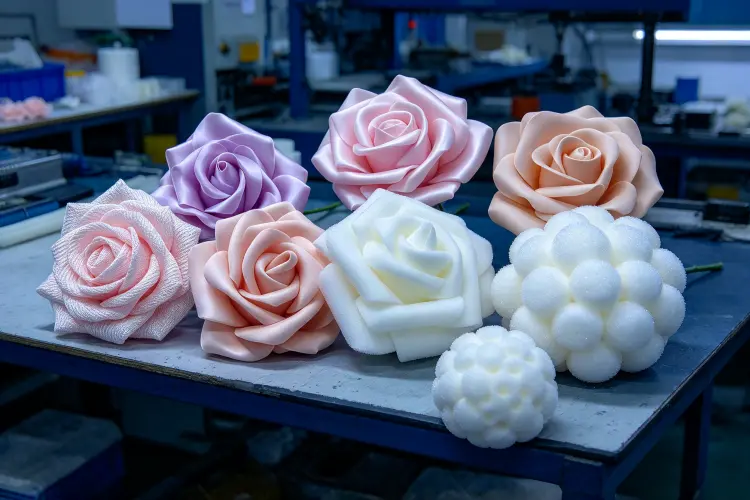
Order Material-Specific Sample Packs
Xibo Floral: Request physical swatches in silk, PE, PU, and foam — compare texture, weight, and color saturation before committing to bulk. MOQ 1 sample box, ships worldwide.
Request Material Sample PackThe Four Main Artificial Flower Materials
Almost every artificial flower on the market falls into one of four material families. There are sub-variants — velvet, chiffon, latex, EVA foam — but these four cover roughly 95% of commercial production.
1. Silk (Polyester Fabric)
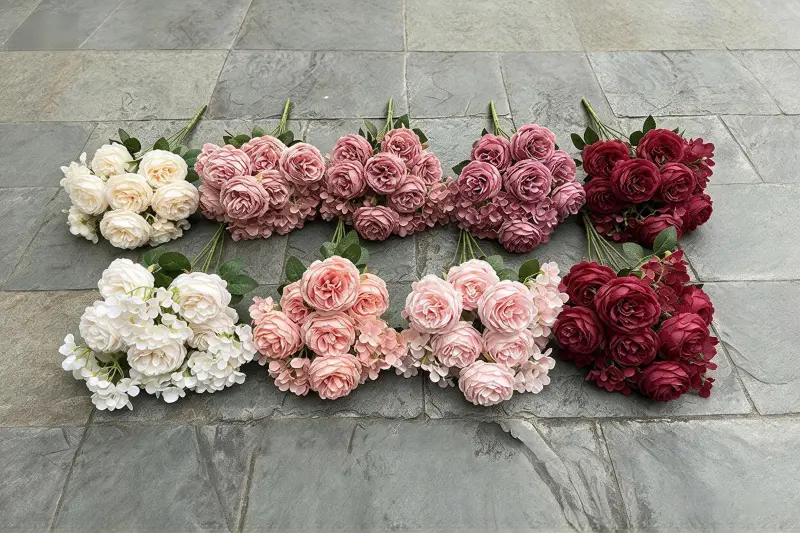
The original artificial flower material and still the most common. Despite the name, "silk" in the artificial flower industry means woven polyester fabric — usually 50D to 75D polyester, cut into petal shapes and heat-set to create a natural curve. It is the most realistic-looking material for individual blooms: roses, peonies, hydrangeas, and ranunculus all look convincing in silk. The downside is that it frays at the edges unless heat-sealed, and it absorbs water (so it cannot be cleaned with water). Best for: Centerpieces, bouquet arrangements, individual stem products. Cost range: $0.30–$1.20 per bloom depending on size and layering. Rental lifespan: 30–50 events with careful handling.
2. PE (Polyethylene)
PE is a soft, moldable plastic that is injection-molded into petal shapes. It is the material behind most budget flower walls, cheap bouquets, and mass-market wedding decor. PE flowers are waterproof, never fray, and hold their shape perfectly. The trade-off is that they look plastic — under studio lighting or from a distance they are fine, but up close, a buyer can tell in seconds. PE is also the material most prone to UV fading, which matters for outdoor installations. Best for: Budget flower walls, outdoor events, temporary decor, props where realism is not the priority. Cost range: $0.15–$0.50 per bloom. Rental lifespan: 15–25 events; petals may become brittle in cold storage.
3. PU (Polyurethane / Real-Touch)
PU is the premium material. It is a soft, flexible foam-like polymer that is molded around a fabric core to create the real-touch feel — the material that makes a hydrangea or an orchid feel like it has a slightly fleshy petal, not a plastic sheet. PU flowers are used in high-end wedding work, luxury hotel lobbies, and premium retail displays. They are more expensive than silk or PE, but they photograph beautifully and pass close-up inspection. Best for: Luxury wedding installations, high-end retail displays, premium flower walls, close-up photography backdrops. Cost range: $0.80–$2.50 per bloom. Rental lifespan: 50–80 events with proper storage.
4. Foam (EVA / Latex Foam)
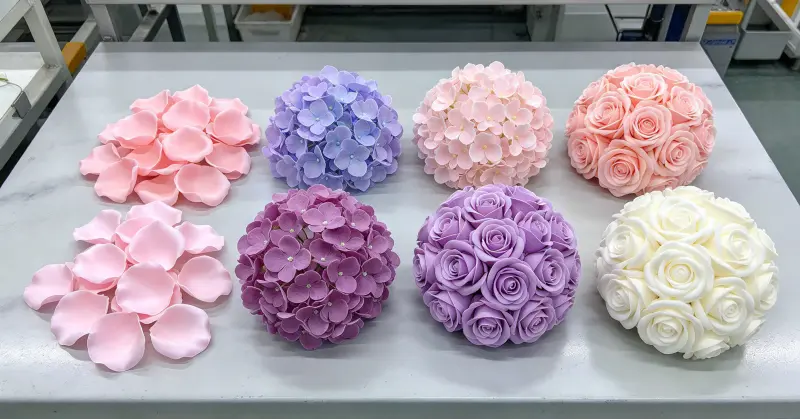
EVA foam and latex foam are lightweight, moldable materials used for foam roses, topiary balls, and shaped flower products. Foam flowers hold a perfect dome shape, are nearly indestructible, and weigh almost nothing. The trade-off is that they look distinctly foamy — they are not convincing as "fresh flowers," but they are excellent for structured decorative pieces where shape matters more than petal realism. Best for: Flower balls, topiary trees, shaped letter/number arrangements, decorative balls. Cost range: $0.25–$0.80 per piece. Rental lifespan: 40–60 events; foam can dent under pressure but rebounds.
Material Comparison Table: Cost, Lifespan, and Feel
The table below summarizes the four materials side by side. These are factory-direct prices for bulk orders (MOQ 500 pcs per design) and reflect our 2026 production costs in Zhengzhou. Retail prices in the US or EU are typically 3–5x these numbers.
| Material | Cost per Bloom (Bulk) | Realism Score (1–10) | Rental Lifespan | Best For | Waterproof |
|---|---|---|---|---|---|
| Silk (Polyester) | $0.30–$1.20 | 8 | 30–50 events | Centerpieces, bouquets, close-up arrangements | No |
| PE (Polyethylene) | $0.15–$0.50 | 4 | 15–25 events | Budget flower walls, outdoor, temporary props | Yes |
| PU (Real-Touch) | $0.80–$2.50 | 9.5 | 50–80 events | Luxury weddings, premium walls, close-up backdrops | Slight |
| Foam (EVA/Latex) | $0.25–$0.80 | 5 | 40–60 events | Flower balls, topiary, shaped decor | Yes |
Two things to notice from this table. First, the realism gap between PE and PU is enormous — nearly 5 points on a 10-point scale — yet the price gap is only $0.50 to $2.00 per bloom. For a rental business, that gap is recovered in the first two events because PU flowers can command a 30–50% higher rental fee. Second, silk sits in the middle: it is realistic and reasonably priced, but it is not waterproof. If your installations will be outdoors or near water features, silk will mildew over time.
Which Material for Which Product Type
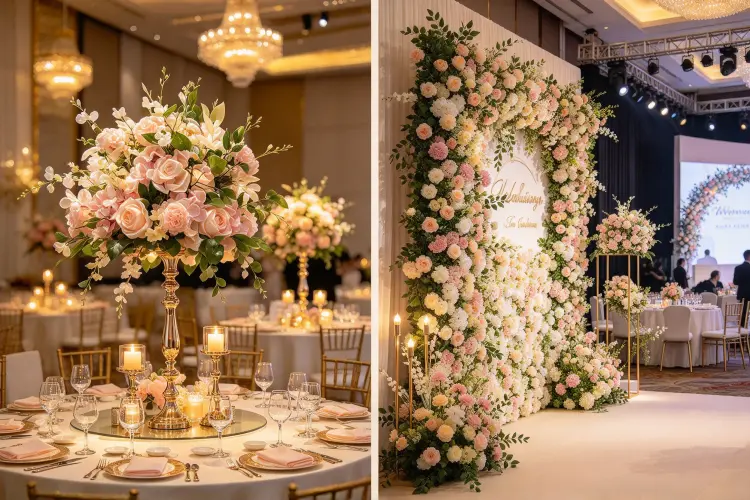
You do not need to use the same material for everything. In fact, the smartest rental and procurement businesses mix materials based on what each product needs. Here is how we recommend allocating materials across your product line.
| Product Type | Recommended Material | Why | Cost per Piece (Bulk) |
|---|---|---|---|
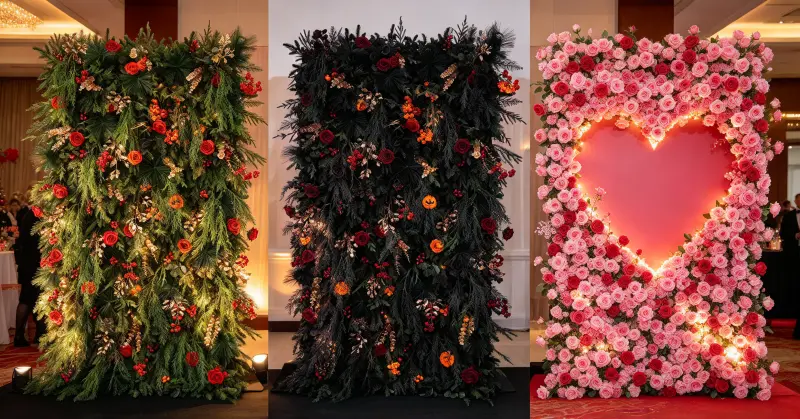
| Flower wall (photo backdrop) | Silk face + PE backing | Visible face needs realism; backing is hidden so PE cuts cost | $45–$120 per panel (6x4ft) |
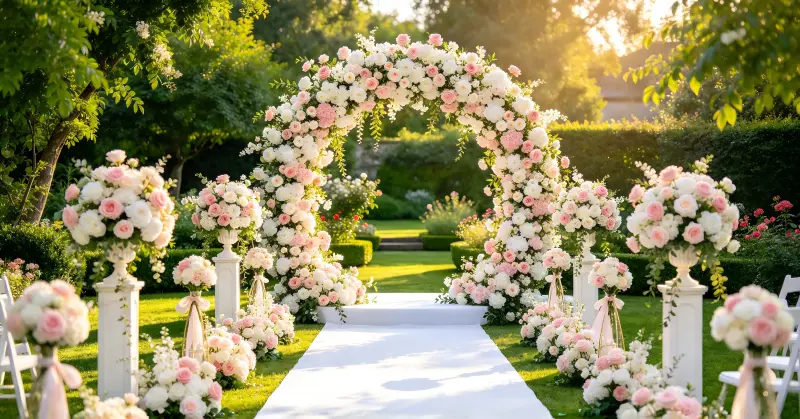
| Wedding arch / moon gate | Silk or PU mix | Arches are photographed at close range; PE looks cheap up close | $120–$350 per arch |
| Centerpieces / table decor | Silk | Guests sit 2ft away; realism matters; silk is the value sweet spot | $8–$25 per arrangement |
| Flower ball / topiary | Foam | Shape is the feature; foam holds a perfect dome and weighs nothing | $6–$20 per ball |
| Outdoor installations | PE (UV-treated) | Silk mildews outside; PU is expensive to expose to weather; PE is waterproof | $30–$80 per panel |
| Luxury / high-end backdrops | PU (real-touch) | Clients pay premium for texture; PU passes close-up inspection | $200–$500 per panel |
The single most cost-effective strategy we see successful rental companies use is the hybrid flower wall: silk flowers on the visible front face (where they photograph beautifully) and PE flowers on the back and edges (where nobody sees them). This cuts the cost of a flower wall panel by roughly 35% without any visible quality loss. We build this as a standard option at Xibo Floral, and it is one of our most requested configurations for clients who buy 10+ panels at a time.
Factory Perspective: How Material Drives Cost
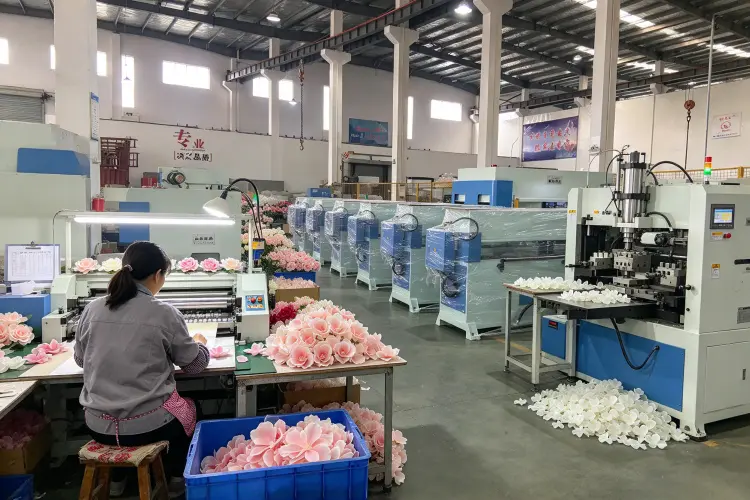
When you ask a factory for a price quote, the material is only the first cost driver. The second is the construction method, and the two interact in ways buyers rarely account for. Let me explain what happens on our production floor so you can ask better questions.
A silk flower goes through roughly 12 steps: fabric cutting, petal shaping, dyeing, layering, gluing to stem, and quality inspection. A PE flower goes through 4 steps: mold injection, cooling, trimming, and inspection. That difference in process time is why silk costs 2–3x more than PE even though the raw material costs are similar. A PU flower is more labor-intensive than silk because each petal is hand-coated, which is why it costs 2–3x more than silk.
There are three cost levers you can control as a buyer:
- Order quantity: MOQ for silk designs is typically 500 pcs per color. PE designs have lower MOQs (100–200 pcs) because molds are reusable. If you are testing a new design, start with PE; once it sells, switch to silk for the visible face.
- Material mix: As noted above, mixing silk (visible) and PE (hidden) cuts 30–40% off a flower wall quote. Always ask if the factory offers this option.
- Custom color vs. stock color: Stock colors (white, blush, ivory, sage) ship in 15–25 days at standard pricing. Custom Pantone colors add 7–15 days and a dye-setup fee of roughly $80–$150 per color. We cover this process in detail in our custom color matching guide if you want the full picture.
One quality note: the cheapest PE flowers on Alibaba are made from recycled plastic that smells strongly when shipped in a container. We use virgin PE resin for all our production, which means no chemical smell and no brittleness after 6 months in storage. If a quote seems too good to be true, ask whether the factory uses virgin or recycled material. This is a question that separates serious suppliers from trading companies.
Five Material Mistakes Buyers Make
After years of handling replacement orders and complaint tickets, these are the five mistakes that come up again and again.
Mistake 1: Ordering PE flowers for a "realistic" wedding backdrop. PE flowers look fine in a catalog photo with studio lighting. At a wedding, where guests walk within 2 feet and photograph on phones, the plastic sheen is obvious. If your client wants a luxury wedding look, do not cut corners on the face material.
Mistake 2: Using silk for outdoor installations. Silk absorbs moisture and mildews. If your installation will be outdoors for more than one event, use UV-treated PE or PU. Silk belongs indoors, period.
Mistake 3: Buying the same material for every product. A flower ball does not need silk — foam is cheaper, lighter, and holds a better shape. A centerpiece does not need PU — silk is 70% cheaper and looks identical at table distance. Match the material to the use case.
Mistake 4: Skipping the sample order. Photos on a factory website show the best possible lighting. Always order a physical sample box — we ship sample packs globally, and you can feel the difference between silk, PE, PU, and foam in person. A $30 sample box prevents a $10,000 container mistake.
Mistake 5: Asking "what material is this" without specifying the grade. "Silk" can mean anything from a thin single-layer polyester that frays in a month to a heavy double-layer heat-set fabric that lasts 50 events. Ask for the denier (50D vs. 75D), the layer count, and whether edges are heat-sealed. These details tell you whether the quote is for a budget product or a rental-grade one.
Sourcing Guide: Questions to Ask Your Factory
When you request a quote, send these six questions in your first message. A factory that can answer all six clearly is a serious manufacturer; a trading company will give vague answers or deflect.
- "What material is the visible face of this flower wall — silk, PE, PU, or a mix?" — This tells you whether they understand material allocation.
- "What denier is the silk? Is it single-layer or double-layer? Are the edges heat-sealed?" — Real factories know these specs off the top of their head.
- "Do you use virgin or recycled PE resin? Can you confirm no chemical smell after container shipping?" — Recycled PE smells and gets brittle; this separates quality suppliers.
- "What is the MOQ per color? What is the lead time for stock colors vs. custom Pantone colors?" — Stock: 15–25 days. Custom: +7–15 days. If they cannot give you these numbers, they are a middleman.
- "Can you send a physical sample pack before bulk order? What is the sample cost and turnaround?" — We charge a nominal sample fee and ship within 3 days. Any factory that refuses samples is a red flag.
- "What is the rental lifespan you guarantee? How many assemblies before replacement?" — A factory that gives you a number (30/50/80 events) stands behind its product. A factory that says "very durable" is selling hope.
If you are comparing multiple suppliers, use the bulk buying savings guide to calculate the total landed cost — including shipping, duties, and replacement rate — not just the unit price. The cheapest unit price often becomes the most expensive total cost when the replacement rate is high.
FAQ
In the artificial flower industry, "silk" means woven polyester fabric, not natural silk. Natural silk flowers are extremely expensive and rare in commercial production. When you see "silk flowers" on Alibaba or in a factory catalog, it is 100% polyester fabric, typically 50D or 75D denier. The quality comes from the weave density, the number of petal layers, and the heat-setting process — not from natural silk fibers. A double-layer 75D polyester flower will look and feel more realistic than a single-layer 50D one, even though both are marketed as "silk."
For a rental business building a general inventory, the answer is silk for visible face products + PE for hidden structures. Silk centerpieces and silk-faced flower walls command rental prices that recover the purchase cost in 3–5 events. PE backing panels cut your total capital outlay by 30–40% without any visible quality loss. PU is worth it if you specifically target luxury wedding clients who will pay 30–50% more for real-touch quality, but it is overkill for a general rental fleet. Foam is the right choice for flower balls and topiary where shape, not petal realism, is the selling point.
Yes, and this is actually the most cost-effective approach. A typical 6x4ft flower wall panel uses silk or PU flowers on the front face (the side guests see and photograph) and PE flowers on the back and edges (which are never visible). This hybrid construction cuts the panel cost by roughly 35% compared to an all-silk wall, while the visible side looks identical. We build hybrid walls as a standard option at Xibo Floral — just ask for the "silk face + PE back" configuration when you request a quote.
With proper storage in a climate-controlled, dry environment, the lifespans are: silk 2–3 years (protect from dust and moisture), PE 1–2 years (UV-treated PE lasts longer outdoors but indoor PE remains stable for 3+ years), PU 3–5 years (keep out of direct sunlight to prevent yellowing), and foam 4–6 years (foam is the most stable under storage conditions). The biggest storage killers are humidity (which causes silk mildew and PE brittleness), dust (which discolors light-colored flowers), and heat (which causes PU to yellow and foam to deform). Store in sealed bags or plastic bins, off the floor, and away from direct sunlight.
For stock colors and standard materials, MOQ is typically 100–500 pcs per design depending on the factory. For custom Pantone colors, the MOQ increases to roughly 500 pcs per color because dye runs require a minimum batch size. For PU real-touch products, MOQ is higher because the molding process is more labor-intensive — usually 300–500 pcs per design. Sample orders are always available at 1–10 pcs so you can test quality before committing to bulk. If you are a new buyer starting out, order a sample box first, then start with a small bulk order (200–500 pcs) to validate the product before scaling.
Yes, material weight affects shipping significantly. Foam flowers are the lightest (roughly 150g per flower ball), silk is medium (2–5g per bloom), PE is heavier (5–10g per bloom due to the plastic density), and PU is the heaviest (8–15g per bloom due to the foam-polymer coating). For a container shipment of 10,000 flowers, the weight difference between foam and PU can add $200–$400 in ocean freight. This is another reason to mix materials: use lightweight foam for structural pieces and heavier PU only on the visible face where it matters.
Not Sure Which Material Fits Your Product Line?
Xibo Floral: Request a free material sample pack — silk, PE, PU, and foam swatches shipped to your door. Compare texture, weight, and color saturation before ordering bulk. 4000㎡ factory, MOQ 1 piece for samples, ships to 80+ countries. We help you match the right material to each product in your catalog — no upselling, just honest factory advice.
Request Your Material Sample Pack