- What a Wholesale Flower Arch Costs in 2027
- Why Two Quotes for the Same Arch Differ by 3x
- Five Arch Shapes and What They Do to the Price
- Where Your $100 Actually Goes
- The One Spec That Decides Whether You Got What You Paid For
- Landed Cost: Freight Changes the Answer More Than the Unit Price
- Nine Questions to Ask Before You Pay a Deposit
- What We Quote, and What We Refuse to Quote
- FAQ
What a Wholesale Flower Arch Costs in 2027
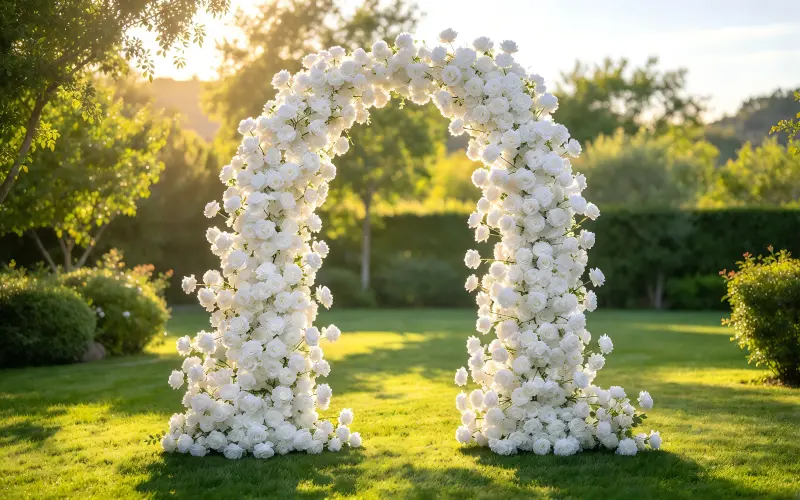
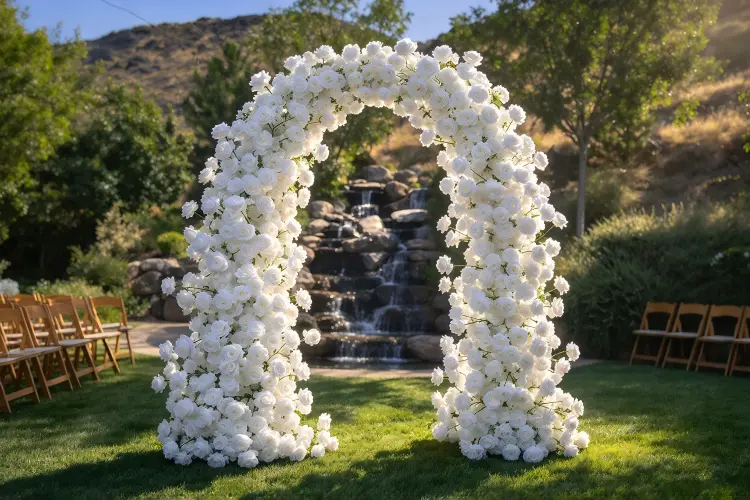
A wholesale artificial flower arch costs $33–$292 per arch in 2027. The spread is set by density, frame, and shape, not by markup. A 1.5m horn arch with three-layer roses runs $33–58. A 2.2m round arch with five-layer roses runs $115–175. A 2.6m custom luxury arch runs $250–292. Sea freight adds $15–35 per arch; express adds $70–140.
That range looks wide because "flower arch" covers five different products. A proposal arch for a rooftop and a hotel lobby arch that gets rented 50 times a year are not the same item, even when both are photographed against a white wall. The table below is our 2027 factory quote bands, before freight.
| Arch Size and Shape | Flower Density | Wholesale Price per Arch | Typical Use |
|---|---|---|---|
| 1.5m horn arch | 3-layer roses, 22–26 clusters per meter | $33–58 | Proposal, photo corner, small shower |
| 1.8–2.0m horn or round | 3–4 layers, 28–32 clusters per meter | $62–110 | Chapel aisle, beach ceremony |
| 2.2m round | 4–5 layers, 34–38 clusters per meter | $115–175 | Main ceremony backdrop |
| 2.4m premium round or heart | 5 layers, 38–45 clusters per meter | $185–245 | Hotel, rental fleet, luxury wedding |
| 2.6m custom | 5 layers plus trailing vine, 45+ clusters per meter | $250–292 | Outdoor stage, brand activation |
For an outside check on the band: Alibaba listings in November 2026 ran from $23–$45 per meter of silk garland and $79–$520 per complete set. Convert the per-meter listings to one arch and the two sources land in the same territory. The numbers below are our factory quote, before freight.
Three things about this table matter more than the numbers.
- It is per arch, complete. Frame, flowers, and the bottom "skirt" of stems are included. A supplier quoting "frame only" is selling you a metal hoop, not a flower arch.
- MOQ is 2 pieces at our factory, because arches ship as a pair of horns plus a top section, and one box protects the other. A single-arch order is possible but pays a small-order surcharge.
- Prices hold for orders placed by 31 March 2027. Silk and freight both move; we lock the unit price for 90 days after deposit.
One note on timing. Silk yarn moved 6–9% between January and October 2026, and our 2027 list carries a 4–6% increase over 2026 on orders below 20 arches. Above 50 arches we hold 2026 pricing, because the setup cost per arch drops once the line is running. If a 2027 quote comes in 30% below a 2026 quote for the same photo, the difference is density or frame, not efficiency.
Need a Quote Against Your Own Size?
Send the height, shape, and flower density you need. We return a per-arch price with CBM and freight to your port within 24 hours. Current band: $33–292 per arch, MOQ 2 pieces.
Get a Per-Arch Quote in 24 HoursWhy Two Quotes for the Same Arch Differ by 3x
Most price gaps come from the quote unit, not from quality. Chinese suppliers quote per meter of garland, per horn pair, per set, or per "piece" that is actually one side of the arch. A 2.2m round arch needs 5.5–6.5 meters of garland. At $29 per meter, that arch is $160–189. A buyer who reads "$29" and assumes "$29 per arch" will think every complete quote is triple the market.
We see this every week. A rental company gets a $29/m price from one listing and a $150/set price from another, then concludes the second supplier is expensive. Both are quoting the same product at roughly the same total. The only difference is where the decimal lands.
Four Quote Units You Will Meet
- Per meter of garland: the most common on Alibaba. Multiply by 4.5–6.5 meters for a standard arch. Ask whether the frame is included — usually it is not.
- Per horn pair: two side sections, no top. Fine for a "broken arch" look, wrong for a round arch unless you buy the top separately.
- Per set: frame, flowers, and top section. This is the only unit that compares directly with a retail price.
- Per piece: ambiguous. It can mean one horn, one side, or a complete arch. Make the supplier write "complete arch, two horns plus top" on the quotation.
The fix is simple: ask every supplier for a quote on one complete 2.2m round arch, frame included, delivered to your port. Same size, same shape, same unit. Then the numbers are comparable, and the real differences — density, frame gauge, packing — become visible.
Run the math on a horn arch to see how far the unit distorts the comparison. A 2.0m horn needs 4.5–5.5 meters of garland. At $29 per meter, that is $130–160, and the frame is usually extra at $18–30. The same arch quoted as a complete set at $110–150 with the frame included is not cheaper — it is the same product with a different unit. Convert both quotes to "complete arch, frame included, FOB port" before you decide which supplier is expensive.
Five Arch Shapes and What They Do to the Price
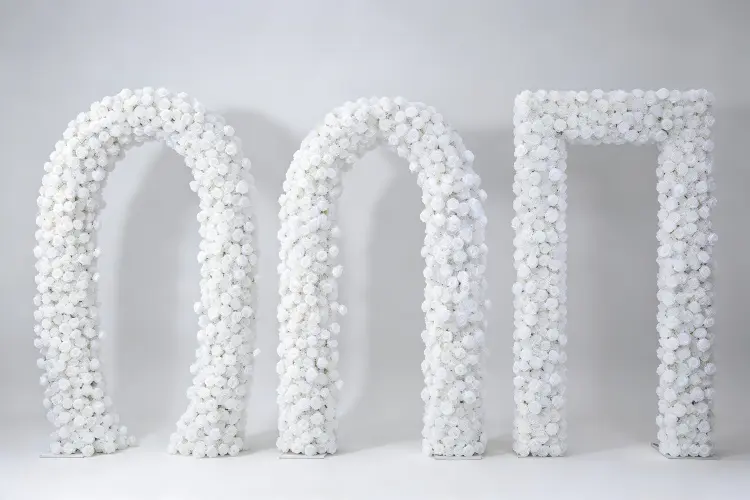
Shape changes the price because it changes how many meters of garland you need and how much hand labor the curve takes. A round arch needs a continuous curve with no visible seam at the top; a horn arch is two straight-ish columns and ships easier. Expect a 10–25% swing between shapes at the same height and density.
| Shape | Typical Span | Garland Needed | Price vs Horn Arch |
|---|---|---|---|
| Round | 2.0–2.4m wide, 2.2–2.6m high | 5.5–6.5m | +10–15% |
| Horn (open top) | 1.8–2.4m wide | 4.5–5.5m | Baseline |
| Square | 2.0–2.4m wide | 6.0–7.0m | +5–8% |
| Heart | 2.0m wide | 6.0–7.0m | +15–25% |
| Broken or asymmetric | 1.8–2.4m wide | 4.0–5.0m | −10% |
Two shape notes that suppliers rarely volunteer. First, a square arch needs rigid corners; if the frame is thin, the corners sag under the weight of dense flowers, and the "square" becomes a rounded blob in photos. Second, a heart arch is mostly labor: the inner curve is tight, clusters have to be tied by hand rather than wrapped, and that is where the 15–25% goes.
Moon gates are a separate product with their own pricing logic, covered in our Moon Gate Arch Wholesale Price Guide. If you are choosing between shapes for a rental fleet, the round vs hexagon vs square comparison covers utilization and storage, not just price.
Where Your $100 Actually Goes
On a $150 arch, roughly $85–93 goes into flowers, $30–37 into the frame, $15–22 into labor, and $8–12 into packing. That is why two arches with the same photo can differ by $60: the money is in the flower count, and the flower count is invisible at thumbnail size.
| Component | Share of Price | What Drives the Cost | How Buyers Get Downgraded |
|---|---|---|---|
| Flowers | 55–62% | Clusters per meter, petal layers, stem count | Fewer clusters, thinner stems, smaller heads |
| Frame | 20–25% | Steel tube gauge, welding, folding joints | 0.8mm tube sold as 1.2mm, spot welds instead of full welds |
| Labor | 10–15% | Wire-tying by hand versus glue-gunning | Glued heads that drop after two rentals |
| Packing | 5–8% | Carton count, liners, compressed volume | Compressed carton that crushes the top section |
The frame number deserves a second look. A 2.2m arch carries 8–14kg of flowers, and the top section carries most of it. At 0.8mm wall thickness, a steel tube bends during the second or third setup; at 1.2mm, it holds. The price difference between those two tubes is about $4–6 per arch, and the difference in rental life is the difference between replacing the frame in year one and using it for fifty events.
Labor is the line most likely to be cut without telling you. Wire-tying takes roughly 40% longer than glue-gunning, but a wire-tied head survives handling. Glue fails in heat, and it fails silently — the arch looks fine at handover and sheds flowers by the end of the reception. Ask one question: "Are the heads wire-tied or glued?"
The One Spec That Decides Whether You Got What You Paid For
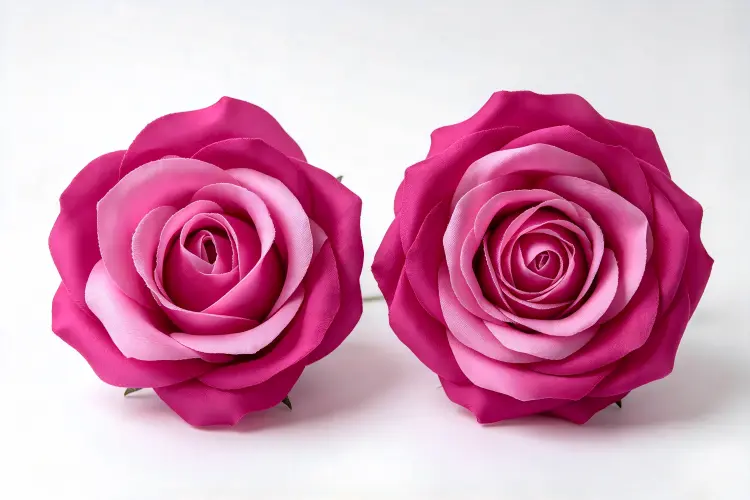
Ask for three numbers before you compare any quote: clusters per meter, layers per flower, and stems per cluster. In our workshop, a standard arch runs 22–26 clusters per meter with three-layer flowers. A premium arch runs 38–45 clusters per meter with five-layer flowers. Same height, same shape, roughly double the flowers, roughly double the price.
- Clusters per meter sets how full the arch reads from two meters away. Below 20, gaps show between clusters when the arch is backlit.
- Layers per flower sets how it reads in close-up photos. A three-layer rose looks flat at 30cm; a five-layer rose keeps depth.
- Stems per cluster sets the silhouette. Three to five stems gives a natural spray; a single thick stem looks like a bouquet glued to a hoop.
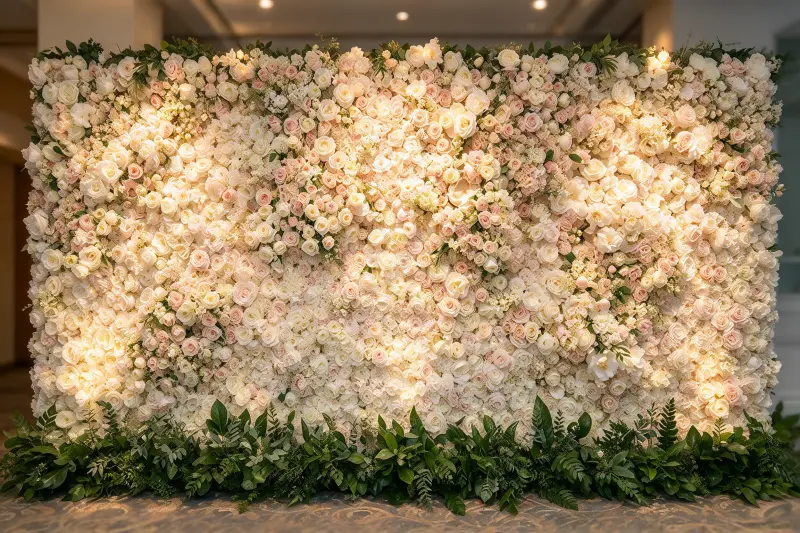
Photographs hide all three. A dense arch shot against a white wall and a sparse arch shot with a shallow depth of field can look identical on a phone screen. This is not deception by the supplier alone — buyers ask for "a photo of the arch" instead of "a photo of one meter, unedited."
Suppliers resist density numbers for a reason: density is the easiest place to cut cost without changing anything a buyer can see at a glance. A 30-cluster arch and a 22-cluster arch use the same frame and the same carton. The only difference is on the invoice. Once you write "38–45 clusters per meter, five-layer heads" into the purchase order, the quote stops moving in the wrong direction.
The 1-meter test: before a bulk order, ask for a one-meter sample section at production density, not a full arch. Weigh it, count the clusters, and squeeze a flower head. A full arch sample tells you the shape; a one-meter section tells you the spec. The sample costs $15–30 and settles the argument.
Landed Cost: Freight Changes the Answer More Than the Unit Price
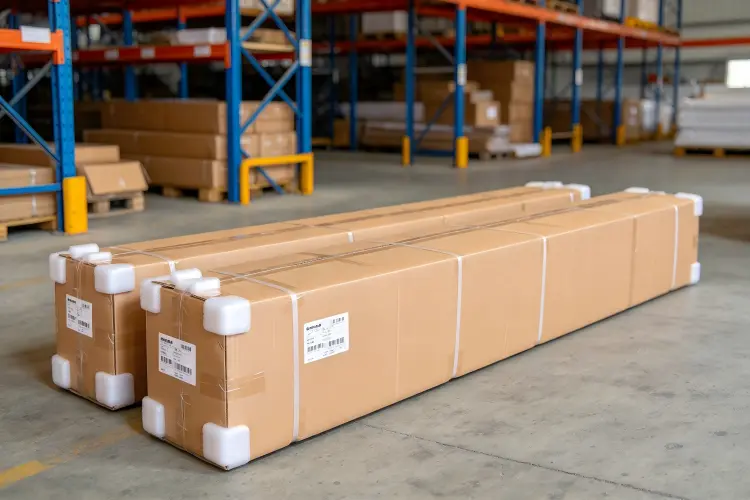
A 2.2m arch packs into two cartons at 0.22–0.30 CBM. At 2026 LCL rates to the US West Coast, that adds $15–35 per arch by sea, or $70–140 by express for a one-off sample. A $10 saving on the unit price disappears if the supplier's carton is 0.1 CBM larger.
| Shipping Method | Transit Time | Freight per Arch | Order Size |
|---|---|---|---|
| Express (DHL/FedEx) | 3–7 days | $70–140 | 1–2 samples |
| Sea LCL | 25–35 days | $15–35 | 20–100 arches |
| Sea FCL | 30–45 days | $8–18 | 150+ arches |
Two costs sit outside the freight line. Duty is assessed on the declared value under HS 6702.90 for artificial flowers, and the rate depends on the current Section 301 list — confirm it with your broker rather than with a supplier. Destination charges (port handling, delivery, customs clearance) are usually $80–200 per shipment, not per arch, which is why small orders feel expensive per unit.
If you are comparing EXW, FOB, and CIF quotes, put all three on the same Incoterm before you decide. We quote EXW Zhengzhou, FOB Ningbo or Shanghai, and CIF to your port; payment is 50% deposit and 50% before shipment. The deposit side of the transaction has its own red flags, covered in paying a Chinese flower factory.
Here is a landed-cost example on a $150 arch, shipped by sea LCL in a 30-arch order. Freight at $25 per arch. Duty at 6% of the declared value, or $9 — treat 6% as a planning figure and confirm the current HS 6702.90 rate with your broker. Destination charges of $6 per arch, and a $15 forwarder fee spread across the order. Landed cost lands near $190 before storage. If the arch rents at $180 per event, it covers its landed cost in two bookings once you account for delivery and labor — which is the number that decides whether a cheap arch is actually cheap.
Nine Questions to Ask Before You Pay a Deposit
These nine questions turn a price into a comparable price. Ask them in writing, and ask every supplier the same nine. The answers expose the unit, the density, and the hidden costs in about ten minutes.
- Is this price per complete arch or per meter? If per meter, ask for the total meters needed for the height you want.
- Does it include the frame and the top section? A horn pair is not a round arch.
- How many clusters per meter, and how many layers per flower? No answer means no comparable quote.
- What is the steel tube thickness? 1.2mm is the working minimum for a rental arch; 0.8mm is decor-only.
- Are heads wire-tied or glued? Wire for reuse, glue for one-time events.
- How many cartons, and what is the total CBM? This decides your real freight cost.
- What is the MOQ, and what is the sample lead time? Ours is 2 pieces and 1–3 working days.
- What is the bulk lead time, in writing? Ours is 7–15 working days after deposit and artwork approval.
- What is the spare-head policy? We include 5–10% extra flower heads per order; a supplier who ships zero spares expects you to reorder for one broken stem.
What We Quote, and What We Refuse to Quote
We are a 4,000㎡ artificial flower factory in Zhengzhou, China. For arches, we quote one number per complete arch, including frame, flowers, and top section — not a per-meter number that you have to multiply in your head. Our current band is $33–292, with MOQ 2 pieces, samples in 1–3 working days, and bulk production in 7–15 working days.
We refuse two kinds of business. We do not quote a 0.8mm frame as a rental-grade arch, because it will come back to us as a complaint in year two. And we do not quote a density we cannot hold in production — if you ask for 45 clusters per meter, the quote will reflect 45, not 28 with a note that says "similar look."
What the price includes: silk fabric flowers on a steel frame, wire-tied heads, a matching bottom skirt, 5–10% spare heads, and export cartons. Indoor life is 3–5 years, outdoor life is 1–2 years under covered or indirect light, and the arch is built for 50+ rental cycles. Custom color matching runs at 90%+ similarity with a 3-day lab dip.
Three inspection points sit behind that number. We check the incoming silk lot for color and weight, count clusters every ten meters on the line, and assemble the full arch for a photo before the carton closes. That photo is sent to you before shipment; if the arch cannot stand without leaning on a wall, you see it while there is still time to fix it.
If you want the sourcing process around the price — supplier screening, sample approval, inspection — the complete arch sourcing guide walks through it. If you are pricing your rental inventory rather than buying it, start with the arch rental revenue case study; the numbers there are per event, not per unit.
Get a Per-Arch Price, Not a Per-Meter Guess
Send your height, shape, and density. We reply within 24 hours with a complete-arch price, carton CBM, and freight to your port. MOQ 2 pieces. Samples ship in 3–7 days by express.
Request a Complete-Arch QuoteFAQ
Seven questions buyers ask before placing a first arch order. Short answers, with the numbers that decide them.
It is real for a 1.5m horn arch with three-layer flowers at 22–26 clusters per meter, ordered in pairs. It is not the price of a 2.2m round arch with five-layer roses. Ask for the height, shape, and density behind any low price; if the supplier cannot give all three, the number is a starting point, not a quote.
A 2.2m round arch needs 5.5–6.5 meters, measured along the curve. A horn arch of the same height needs 4.5–5.5 meters because the top is open. Multiply the per-meter price by those figures before comparing it with a per-set price, or the comparison will be wrong by roughly three times.
Yes. The MOQ is 2 pieces per shape, not per color, so a mixed order of round, horn, and heart arches is accepted. Custom colors add 3 days for a lab dip and 5–7 days to production. Colors are matched to 90%+ similarity; approve a swatch before bulk production, because dye lots vary.
A round arch costs 10–15% more at the same height and density. It uses 1–1.5 more meters of garland, and the top curve has to be tied by hand with no visible seam. A horn arch is two columns with an open top, which ships in smaller cartons and takes less labor.
Custom color adds $12–35 per arch depending on the shade and the batch size, plus a one-time $30–60 lab dip fee for a new shade. Orders above 20 arches usually absorb the lab dip. We match to 90%+ and send a physical swatch for approval before production starts.
One arch can be sampled, with a small-order surcharge of $15–25. Standard samples ship in 1–3 working days by express, and express freight runs $70–140 for one arch. If you approve the sample and place a bulk order of 20+ arches, we deduct the sample surcharge from the invoice.
By sea LCL, $15–35 per arch at 0.22–0.30 CBM. By express, $70–140 for one or two arches. By FCL, $8–18 per arch on orders above 150. Duty and destination charges sit on top; confirm the current rate under HS 6702.90 with your broker before you set a retail price.