The Short Answer: Panels by Backdrop Size
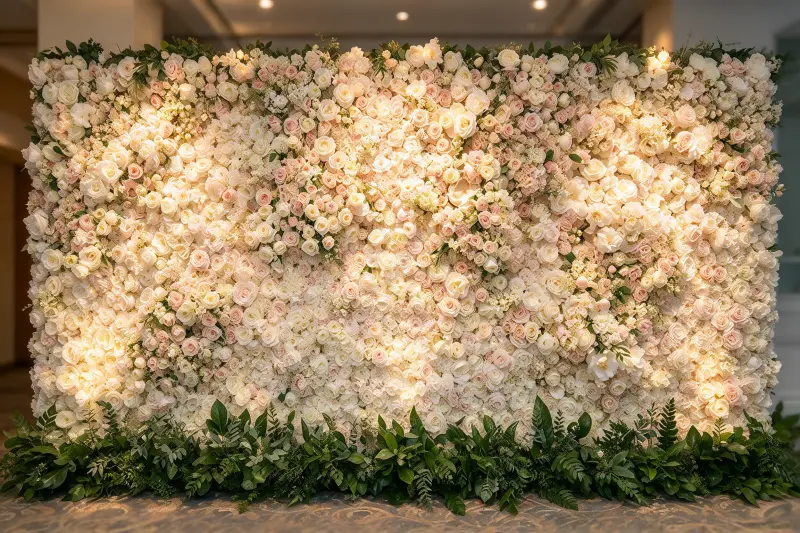
A standard 8×8ft (2.4×2.4m) backdrop needs 24 panels of 40×60cm, laid out 4 across and 6 high. A 10×8ft stage backdrop needs 30 panels, a 6×8ft photo wall needs 18, and a small 4×4ft corner needs 6. Every other size is the same division: width by 60cm, height by 40cm, rounded up.
| Backdrop Size | Panels Across (60cm) | Panels High (40cm) | Total Panels | Actual Covered Area | Typical Use |
|---|---|---|---|---|---|
| 4×4ft (1.2×1.2m) | 2 | 3 | 6 | 1.2×1.2m | Photo corner, small booth, retail display |
| 4×8ft (1.2×2.4m) | 2 | 6 | 12 | 1.2×2.4m | Narrow backdrop, aisle end, door surround |
| 6×8ft (1.8×2.4m) | 3 | 6 | 18 | 1.8×2.4m | Standard photo backdrop, couple portraits |
| 8×8ft (2.4×2.4m) | 4 | 6 | 24 | 2.4×2.4m | Most ordered size, ceremony and photo wall |
| 10×8ft (3.0×2.4m) | 5 | 6 | 30 | 3.0×2.4m | Stage backdrop, wide ceremony wall |
| 10×10ft (3.0×3.0m) | 5 | 8 | 40 | 3.0×3.2m | Large stage, hotel ballroom, exhibition stand |
Two details in that table decide whether your wall looks right. First, the panel is 60cm wide and 40cm tall, not the other way round. Rotate one panel and your whole grid stops lining up. Second, 10×10ft needs 8 rows, so the finished wall stands 3.2m tall and the top row gets trimmed or folded behind the frame — plan that before you order the stand, not after.
How the Grid Math Works
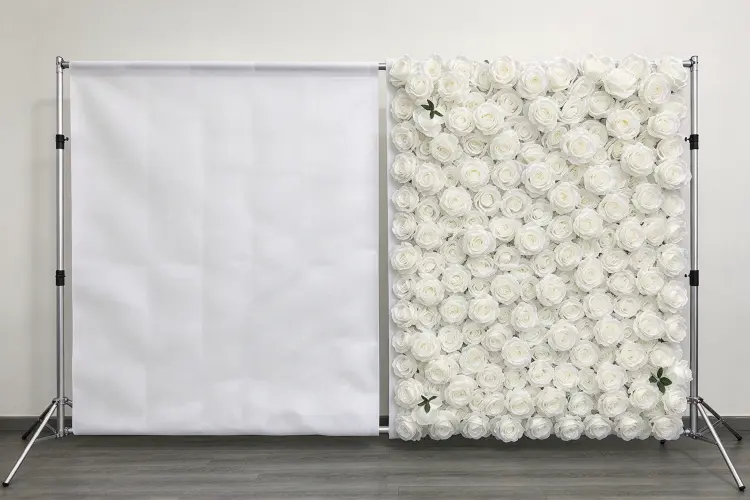
The formula is short enough to do on a phone: columns = width in cm ÷ 60, rows = height in cm ÷ 40, panels = columns × rows, with both divisions rounded up. For a 3.6m × 2.0m wall that is 360÷60 = 6 columns and 200÷40 = 5 rows, so 30 panels. For 2.5m × 2.2m it is 5 columns and 6 rows, 30 panels, covering 3.0m × 2.4m — you trim 50cm off the width rather than leave a gap.
Rounding up is not a rounding error. Panels connect at their edges, so a half-panel gap is a visible strip of frame or wall behind the flowers, and photographers find it immediately. If the venue wall measures 2.3m, you order 4 columns at 2.4m and accept 10cm of overhang at each end, tucked behind a drape or the stand legs.
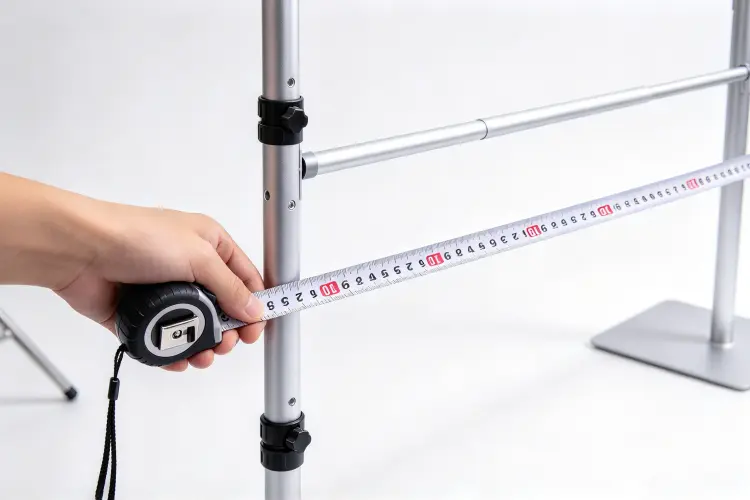
Measure the wall, not the room. The three numbers that change the answer are the finished width, the finished height, and whether the wall stands on a frame or is fixed flat to a venue wall. A frame adds 5–10cm at each side for the legs, so a 2.4m frame covers slightly less than 2.4m of flower face. On a flat wall, the panels sit flush and the full 2.4m counts.
If your measurements are in feet and inches, convert before dividing. One foot is 30.48cm and one inch is 2.54cm, so an 8ft wall is 244cm rather than 240cm. That 4cm matters: 244÷60 is 4.07, still 4 columns, but 244÷40 is 6.1, which rounds up to 7 rows if you feed the number straight into the formula. Round to the nearest practical grid instead — 4×6 covers 240×240cm and leaves 2cm of overhang per side, which the frame absorbs. The mistake to avoid is a 7-row wall that stands 280cm tall and hides your backdrop top behind the venue's drapes.
Send Us Your Wall Dimensions
Xibo Floral: give us the finished width and height in metres, and we will return a panel count, a grid layout, and a carton plan within one working day. No charge, no obligation to order.
Get a Panel CountWhy the Exact Number Falls Short on Site
Order 10% more panels than the grid requires. An 8×8ft wall ordered as 24 panels should be ordered as 26–27, and there are four practical reasons: damaged panels in transit, a spare for a torn flower head on the third rental, edge dressing where the wall meets a stand, and the photographer's crop.
The crop is the one most buyers miss. A photographer framing a couple against an 8ft wall rarely uses the full width — they tighten to roughly 85–90% of it, which pushes the edges of the wall out of frame and puts more visual weight on the centre. That is fine for the photos, but it means the wall reads narrower than it is, so rental companies shooting frequently end up ordering 10–15% wider than the nominal backdrop size. A 9ft finished width is a better working number than 8ft if portraits are the main product.
Overlap matters when the wall is curved. Panels are flat, and forcing them around an arch or a curved frame opens V-shaped gaps at the joins. Curved installations need 15–20% extra because each join overlaps by 2–4cm. This is also why a curved run is usually built from a roll-up wall or a foam-backed arch instead of loose panels.
Spares are inventory, not waste. For a rental fleet running 20 events a season, two spare panels per wall is the difference between a same-week repair and a cancelled booking. Panels are cheap relative to a lost hire, and a matched dye lot cannot be bought later — a replacement panel ordered six months after the original run will not match the first batch. Order the spares with the original production run.
Outdoor installations need a different allowance. Wind load on a flat 2.4m wall is real: panels present a continuous face with no gaps for air to pass, so a wall on a freestanding frame in an exposed courtyard will bow, and the bow opens the joins. For outdoor use, add 5% on top of the standard 10% and plan a mesh backing or a perforated panel type so the wall can breathe. A backlit wall needs the same thinking in the other direction — LED panels sit behind the grid and push it forward, so the finished face is 3–5cm proud of the frame and the top row needs anchoring rather than zip-tying.
Standard Backdrop Sizes and What They Are For
Six sizes cover almost every enquiry we receive, and each maps to a specific event format rather than to a round number. The choice between them is driven by how many people stand in front of the wall and how much of the venue the client wants to fill.
- 4×4ft (6 panels). A corner or booth backdrop for one or two people. Common for retail displays, cake tables, and small brand activations where the wall is a prop rather than the main set.
- 4×8ft (12 panels). A door surround, an aisle end, or a narrow photo spot. Also the standard size for a flower wall fixed between two venue columns.
- 6×8ft (18 panels). The working size for couple portraits and family groups of three to five. It fills a phone camera frame at two metres without showing the room behind.
- 8×8ft (24 panels). Our most ordered size, and the one most rental companies standardise on. Two people fit comfortably, four fit if they stand close, and it reads as a proper installation rather than a prop.
- 10×8ft (30 panels). Stage and ceremony backdrop. Wide enough for a bridal party of six, and the size that looks correct behind a registrar table or a band.
- 10×10ft (40 panels). Ballroom and exhibition scale. At 3.2m finished height the top row sits above head height in photographs, which is what makes a large room look decorated rather than cornered.
Installation time scales with panel count but not linearly. A 24-panel wall takes two people roughly 40 minutes to zip-tie, square up, and dress the seams. A 40-panel wall takes about an hour and ten minutes, because the extra rows need a second person holding the grid while the ties go in. If your crew charges by the hour, that difference is a real cost per hire, and it belongs in your pricing, not in your margin.
What Panel Count Does to Landed Cost
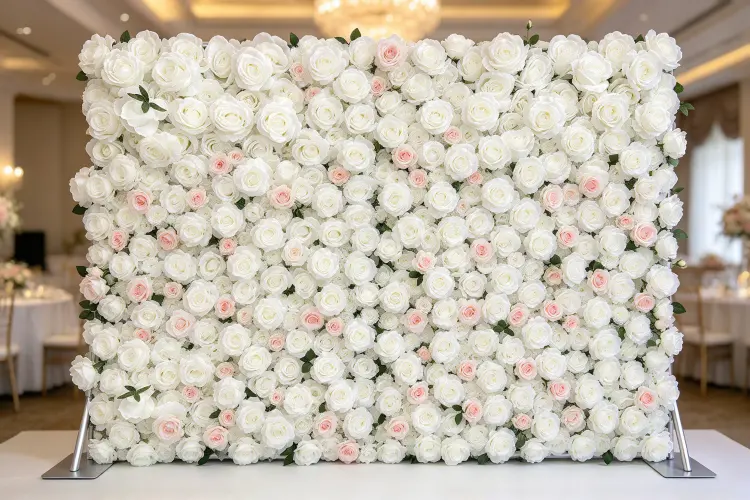
Panel count changes your freight more than your unit price. Below 24 panels you are paying express rates on a small carton; above roughly 120 panels the order moves into sea freight and the per-panel transport cost drops by half or more. The table below prices a single 8×8ft wall at three quality tiers, factory-direct, with express freight to a US address and no duty included.
| Panel Tier | Price per Panel (24+ pcs, FOB) | 24-Panel Wall Cost | Express Freight per Wall | Landed Cost per Sq Ft |
|---|---|---|---|---|
| Budget PE, 15–20 flower heads per sq ft | USD 6–9 | USD 144–216 | USD 80–110 | USD 3.6–5.3 |
| Commercial silk, 30–45 heads per sq ft | USD 13–20 | USD 312–480 | USD 90–130 | USD 6.5–9.8 |
| Premium dense silk, 45+ heads per sq ft | USD 26–35 | USD 624–840 | USD 110–150 | USD 11.8–16.0 |
Those landed figures assume 62 sq ft of finished wall and no import duty. They also assume the panels ship compressed. This is the part that decides whether freight is USD 90 or USD 400: 24 panels packed flat in one carton of roughly 60×40×30cm, about 0.07 m³, instead of 24 individual boxes. Express carriers bill on volumetric weight, and loose individual packing multiplies the billable volume by three or four with no benefit to the goods.
Sea freight changes the arithmetic again. A 20ft container carries roughly 80–120 assembled walls in roll-up form, or well over 2,000 flat panels, so the transport cost per panel falls to a few dollars. That only makes sense once your order is large enough to fill a meaningful part of the container — otherwise you are paying for a container to move air. For orders under five walls, express is usually cheaper once you count the destination charges.
Compare the per-square-foot number, not the per-panel price. Two suppliers quoting USD 14 and USD 17 per panel can land at the same cost per square foot if one ships compressed and the other does not. Our wholesale price guide breaks down the full cost stack, and the damage-free shipping guide covers packing for repeat rentals.
Duty is the number most spreadsheets forget. Artificial flowers clear under HS heading 6702.90, and the 6-digit code is the same whether the panel is silk, polyester or polyurethane. The national tariff line your broker applies splits further by material, though, so a silk panel and a PE panel in the same container can carry different duty rates. Ask your broker for the landed duty rate on the specific material before you compare quotes — a 5% difference on duty outweighs a 5% difference on the panel price, and it never appears in the FOB numbers.
Quantity breaks usually start where the carton ends. Factories price per panel in tiers, and the first meaningful break typically sits at one full carton — 24 panels — with the next at 5 cartons and another at container volume. Ordering 23 panels to save one unit of stock often costs more per panel than ordering 24, because the carton is the production and packing unit. When your grid lands one or two panels short of a carton, take the carton and keep the difference as spares.
Five Quantity Mistakes That Cost Money
Almost every short order we see comes from one of five habits. None of them is exotic, and all of them are cheaper to fix before production than after the container arrives.
1. Ordering the exact area with no spare. A 24-panel wall ordered as 24 panels leaves nothing for a damaged piece, and damage in transit is normal rather than exceptional. Order 26–27 and keep the difference as fleet inventory.
2. Mixing panel sizes in one wall. A 40×60cm panel and a 30×30cm panel do not share a grid. The joins drift by 10cm every row and the wall looks assembled rather than built. If you want a mixed-density design, keep one panel footprint and vary the flower density instead.
3. Forgetting the frame footprint. Stand legs and crossbars sit behind the flower face and eat 5–10cm at each side. A wall specced to the frame's nominal width ends up 10–20cm narrower than the space it was bought for.
4. Sizing to the room instead of the photograph. Photographers crop 10–15% tighter than the wall. If portraits are the product, size up one column rather than matching the venue's nominal backdrop.
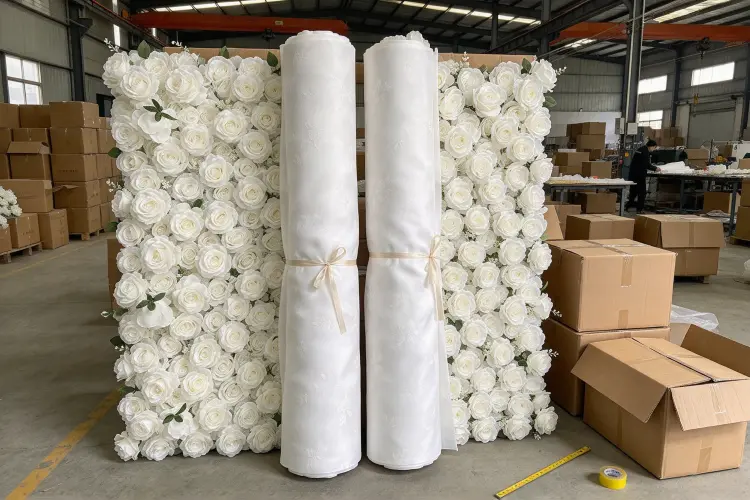
5. Buying panels when a roll-up wall is the better product. Twenty-four panels are the right answer for custom sizes and mixed colours. For a fleet that installs and strikes the same 8×8ft wall every weekend, two 4×8ft roll-ups go up faster and travel flatter. The panel count is correct and the product is wrong. Our roll-up versus panel comparison covers the break-even point in install hours.
How to Order the Right Quantity First Time
The whole process is six steps, and the first two happen at the venue rather than at the factory. Getting these right removes almost all of the back-and-forth that delays first orders.
- Measure the finished width and height in centimetres. Not the room, not the stage opening — the flower face you want people to see. Write both numbers down before you open a supplier's website.
- Divide by 60 and 40, round both up. That gives columns and rows. Multiply for the panel count. Check the result against the table above; if it differs, your measurement is probably in inches.
- Add 10% for spares, 15–20% for a curved run. Round to a whole column or row, because you cannot order two-thirds of a panel.
- Confirm the connector type before you commit. Panels from different factories rarely interlock — pin spacing and grid thickness differ by a few millimetres, which is enough to stop them joining. If you are adding to an existing fleet, send a sample panel or the connector dimensions.
- Ask for compressed carton packing and the carton dimensions in writing. This is the single biggest lever on express freight, and it belongs in the PI, not in a chat message.
- Match the order to your payment terms. Panel orders below USD 10,000 usually run 30% deposit and 70% against a B/L copy after inspection. Our payment terms guide covers the sequence, and the installation walkthrough shows what the finished grid should look like before you sign off.
A sample answers a different question than a spec sheet. One panel shows you flower density, colour accuracy, and how the backing feels, but it cannot show you how the grid reads at 2.4m — seams, repeat rhythm, and whether the density holds up when four panels sit side by side. If you are committing to a fleet, ask for a four-panel mini-grid rather than a single panel. It costs a little more in freight and saves a production run, because the thing that usually goes wrong is the repeat, not the flower.
One last check before you send the PO: ask the factory to send a photo of the panels laid out in your grid on their floor. It takes them ten minutes and it catches the two errors that survive every spreadsheet — a rotated panel and a row count that was rounded down instead of up. On a 24-panel order that photo is worth more than any specification sheet.
FAQ
Twenty-four panels, arranged 4 across and 6 high. An 8×8ft wall is 2.44m × 2.44m; four columns of 60cm cover 2.4m and six rows of 40cm cover 2.4m, which is the closest whole-panel grid to the nominal size. Order 26–27 if the wall will be rented repeatedly, so you have spares from the same dye lot.
A 10×8ft (3.0×2.4m) backdrop takes 30 panels: 5 columns × 6 rows. A 10×10ft (3.0×3.0m) takes 40 panels: 5 columns × 8 rows, which finishes at 3.2m tall and needs the top row trimmed or folded behind the frame. Both sizes are wide enough for a bridal party of six.
Yes, 10% for a flat wall and 15–20% for a curved one. The allowance covers transit damage, a torn flower head after a few rentals, edge dressing at the frame, and the fact that photographers crop 10–15% tighter than the wall. Spares must come from the original production run, because a panel made six months later will not match the dye lot.
Usually not without checking. Interlocking pins, hole spacing, and grid thickness differ by a few millimetres between factories, which is enough to stop two panels joining cleanly. If you need to extend an existing fleet, send the supplier a sample panel or the exact connector dimensions before ordering. Mixing two connector types in one wall produces gaps at the joins that show in photographs.
It depends on how often the same size goes up. For a rental fleet installing an 8×8ft wall most weekends, two 4×8ft roll-ups assemble faster and pack flatter than 24 loose panels. Panels win when you need custom dimensions, mixed colours, or the flexibility to build different shapes from one inventory. Many rental businesses keep both: roll-ups for the standard hire, panels for custom work.
Compressed flat packing puts 24 panels of 40×60cm into a carton of roughly 60×40×30cm, about 0.07 m³, weighing 14–18kg depending on flower density. That volume is what keeps express freight near USD 90–150 per wall. Loose individual packing multiplies the billable volumetric weight by three or four, so always confirm compressed carton packing in the proforma invoice.
About 40 minutes for two people: zip-tie the grid, square the rows, then dress the seams. A 40-panel wall takes roughly 70 minutes because the upper rows need a second person holding the grid while the ties go in. If your crew bills hourly, build that difference into the hire price rather than absorbing it.
Get Your Panel Count and Carton Plan
Xibo Floral: 4000㎡ factory in Zhengzhou, 40×60cm panels in silk, PE, and PU, from 1 panel for a sample to full container loads. Send us your wall width and height and we will return the grid layout, panel count with spare allowance, carton dimensions, and a proforma invoice with the CIF total.
Request a Panel Quote